DR FuelCell is a hydrogen generator specialist with the widest range of fuel compatibility and integrated solutions compared to competitors. Our core technological capabilities consist of five key areas: multi-fuel compatibility, proprietary catalyst development, integrated reactor design, enhanced safety, and CO₂ utilization technology.
Multi-fuel compatibility technology is a differentiated capability that enables processing of various fuel sources—including natural gas, LPG, biogas, ammonia, and e-methanol—on a single platform. It is compatible with all fuel cell systems including low-temperature and high-temperature PEMFC and SOFC, with automatic fuel recognition and optimal operation mode switching. Unlike competitors who specialize in specific fuels, this represents our core competitive advantage in flexibly responding to market changes.
Integrated reactor design technology implements compact systems by optimizing steam reforming and autothermal reforming reactions. Energy efficiency is maximized through heat exchanger optimization, and Balance of Plant (BOP) integration enables seamless operation with fuel cell systems.
Additionally, we produce high-purity hydrogen (99.99% or higher) by reducing CO concentration to below 10 ppm through Water Gas Shift reactors. Our proprietary catalyst technology is the core of our cost competitiveness—we have developed transition metal catalysts for desulfurization and hydrogen production in-house, minimizing dependence on expensive precious metal catalysts. Our Ru-based catalysts for ammonia cracking achieve over 99% decomposition efficiency, and we possess both sphere-type and monolith-type catalyst technologies.
CO₂ utilization technology is key to achieving carbon neutrality. We possess carbon dioxide separation and capture technology and are developing turquoise hydrogen production technology. We are researching technology to simultaneously produce hydrogen and high-value carbon materials without CO₂ emissions through methane pyrolysis. These technologies work complementarily to provide an end-to-end solution from fuel input to high-purity hydrogen production and fuel cell power generation.
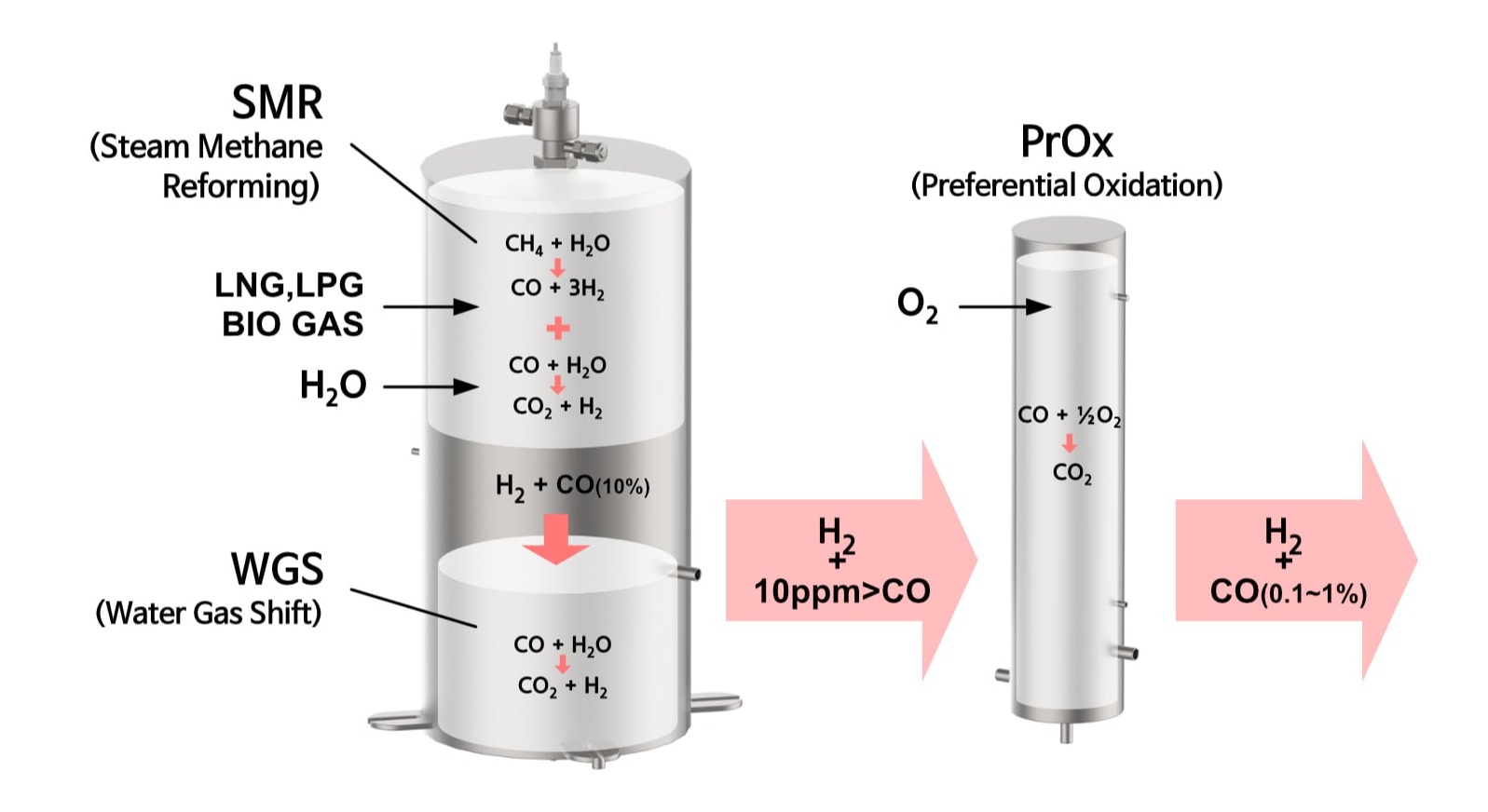
🔹 Integrated 3-Stage Purification Process Design
• SMR (Steam Methane Reforming): Primary hydrogen generation through steam reforming reaction
• WGS (Water Gas Shift): CO conversion to hydrogen via CO + H₂O → CO₂ + H₂ reaction
• PrOx (Preferential Oxidation): Final CO removal to 10ppm level through preferential oxidation
🔹 Technical Advantages
• Variable Purity Control: Hydrogen purity adjustable from 60~99.97% to match application requirements
- For SOFC: 60~75% (CO tolerance)
- For low-temperature PEMFC: 99.97% (CO below 10ppm required)
- For hydrogen blending: 75~95% (cost-optimized)
• Separation & Purification Optimization: Process simplification and energy efficiency improvement through integrated reactor design
• Selective Upgrading Process Application: PSA/Membrane processes can be omitted depending on application
🔹 Differentiation Points
• Conventional Method: Biogas → Upgrading (PSA/Membrane) → Hydrogen Generator → High-purity Hydrogen (excessive steps, high cost)
• DR FuelCell: Biogas → Direct Reforming Hydrogen Generator → Variable Purity by Application (reduced steps, cost savings)
🔹 Commercialization Achievements
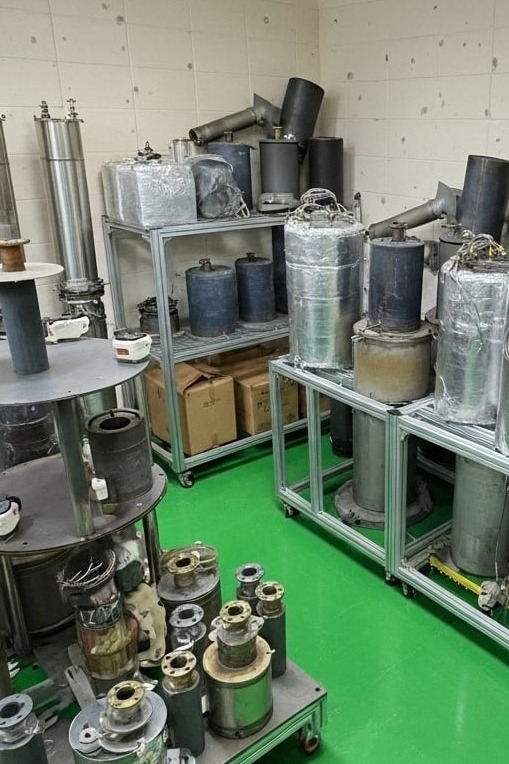
• WGS reactor standalone product completed
• Water Gas Shift (WGS) Reactor: 500Nm³/day-class design and fabrication completed
• Currently supplying to major fuel cell system companies including Donga Fuel Cell, Doosan Mobility Innovation, and S-Fuelcell
🔹 Core Catalyst Technologies
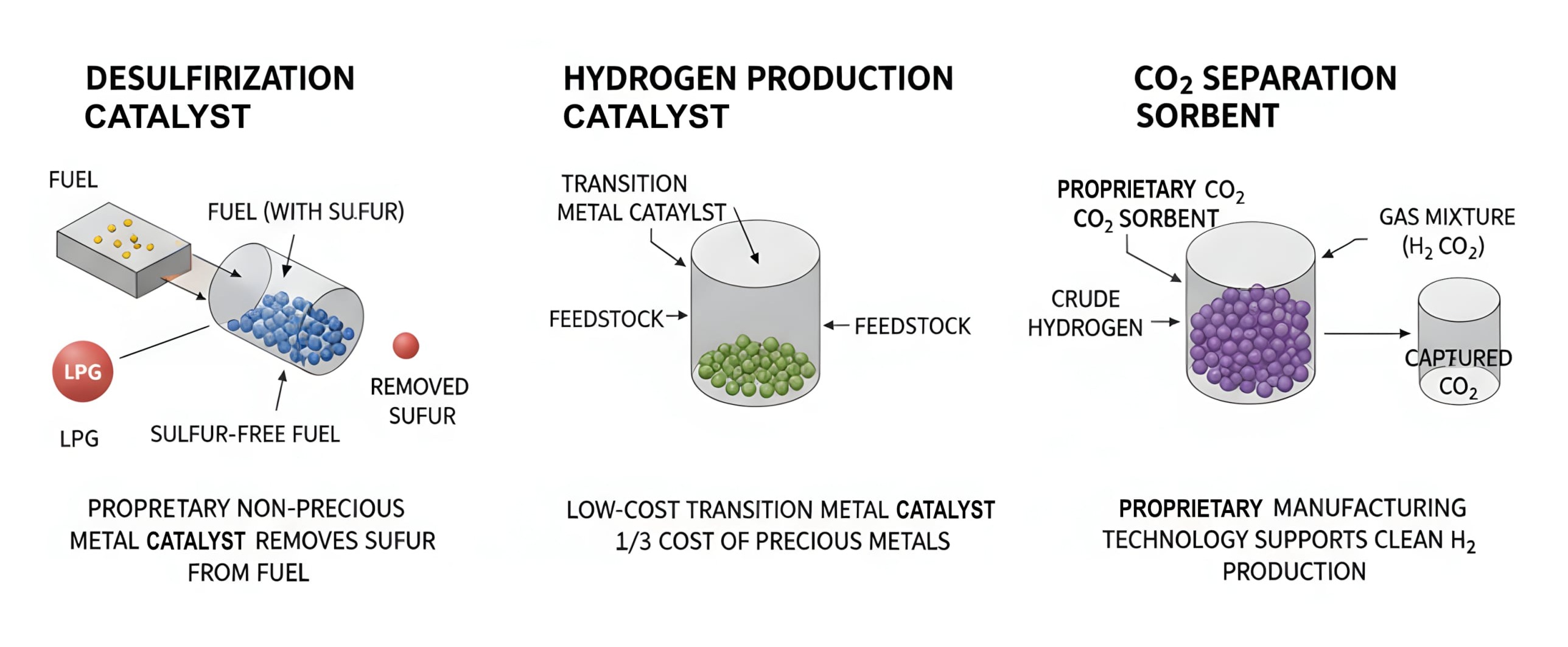
• Desulfurization Catalyst: Proprietary non-precious metal-based desulfurization catalyst removes sulfur compounds from fuel
• Hydrogen Production Catalyst: Low-cost transition metal catalyst achieves 1/3 cost compared to precious metal catalysts
• CO₂ Separation Adsorbent: Proprietary manufacturing technology supports clean hydrogen production
🔹 Technical Advantages
• Reactor Durability Assurance: Long-term durability proven even with domestically-produced non-precious metal catalysts
• Cost Competitiveness: Significant manufacturing cost reduction through proprietary development, while competitors depend on expensive imported precious metal catalysts
• Catalyst Poisoning Prevention: Resistance to impurities such as sulfur in biogas
🔹 Commercialization Achievements
• Supply of catalyst evaluation equipment and desulfurizer to Micopower
• Application and certification completed for domestic fuel cell system companies, additional certification planned for 2025
🔹 Supported Fuels
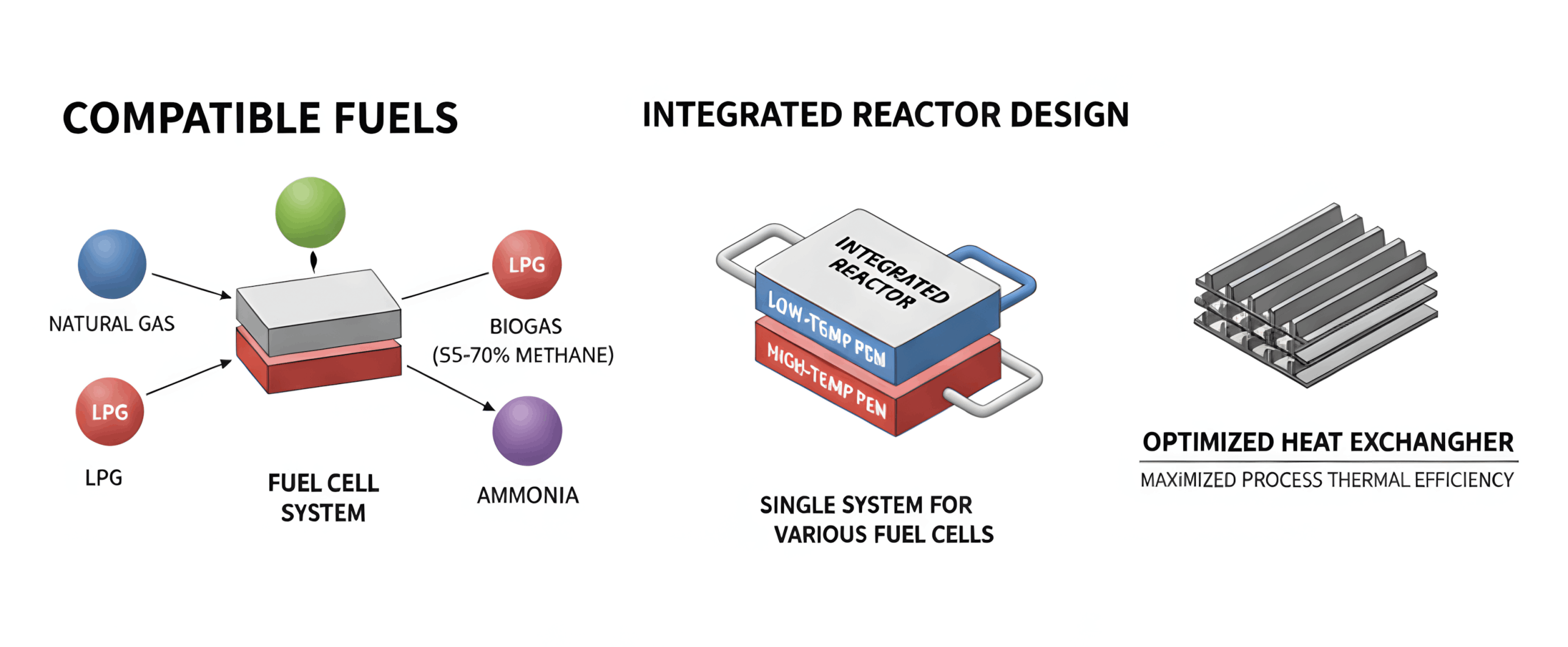
• Fuels: Natural gas, LPG, biogas (55~70% methane concentration), ammonia, and 4+ fuel types
• Integrated Reactor Design: Single system compatible with both low and high-temperature PEM fuel cells
• Heat Exchanger Optimization: Proprietary design technology for maximized process thermal efficiency
🔹 Technical Advantages
• Direct Biogas Reforming: KRW 200 million equipment cost savings (for 50Nm³-class) by eliminating upgrading processes (PSA, Membrane) that were essential in conventional methods
• Variable Hydrogen Concentration Control: Flexible production matching application-specific requirements (60~99.97%)
• Multi-Tube Reactor Design: Improved heat transfer efficiency and prevention of catalyst poisoning (H₂S and other impurities) compared to single-tube design
🔹 Direct Biogas Reforming Technology
• DR FuelCell's direct reforming technology eliminates upgrading processes and directly reforms biogas, providing the following advantages:
• Equipment Cost Reduction: Savings from upgrading equipment (PSA, Membrane) costs (typically 20-30% of total system cost)
• Improved System Operation Efficiency: Enhanced operational efficiency through process simplification
• Reduced Energy Loss: Minimized methane loss occurring during upgrading process
• This technology has been validated through collaboration with Fraunhofer ISE, and 50Nm³-class scale-up is currently underway.
🔹 Safety Systems
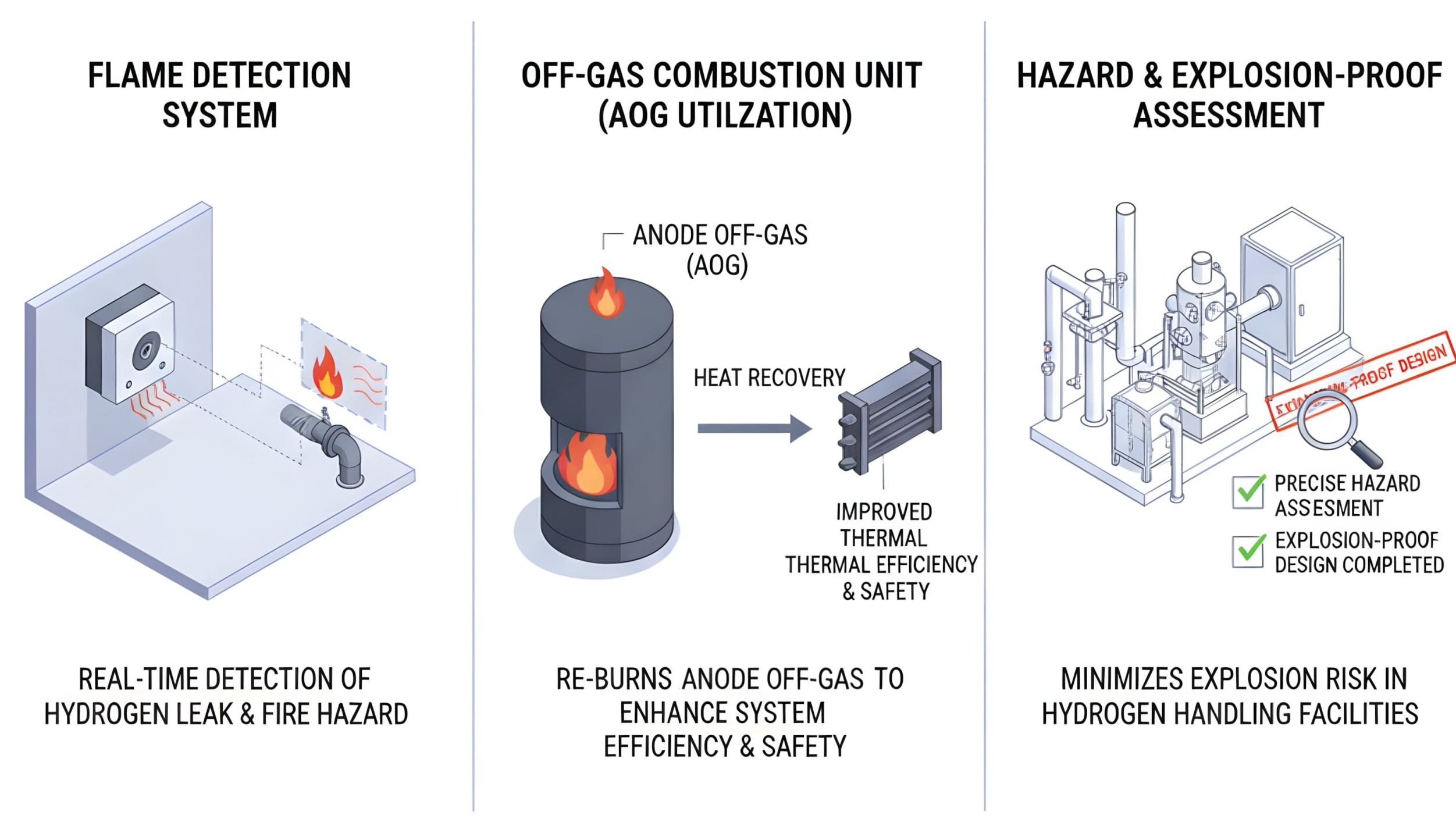
• Flame Detection System: Real-time detection of hydrogen leaks and fire hazards
• Exhaust Gas Combustion Device (AOG Utilization): Improved system thermal efficiency and safety through Anode Off-Gas recombustion
• Precision Risk Assessment and Explosion-Proof Evaluation: Design completed to minimize explosion risks in hydrogen handling facilities
🔹 Technical Advantages
• BOP Integration Optimization: System stability ensured through perfect integrated control between Balance of Plant and reactor
• Smart Operation Technology: Unmanned operation enabled through load control and self-diagnostic functions
• Fast Startup Response: Startup within 2 minutes and load variation response through electric heater-type catalytic pre-reformer
🔹 Commercialization Achievements
• Multiple applications completed for domestic fuel cell system companies
• Startup/shutdown issues resolved and long-term durability verified
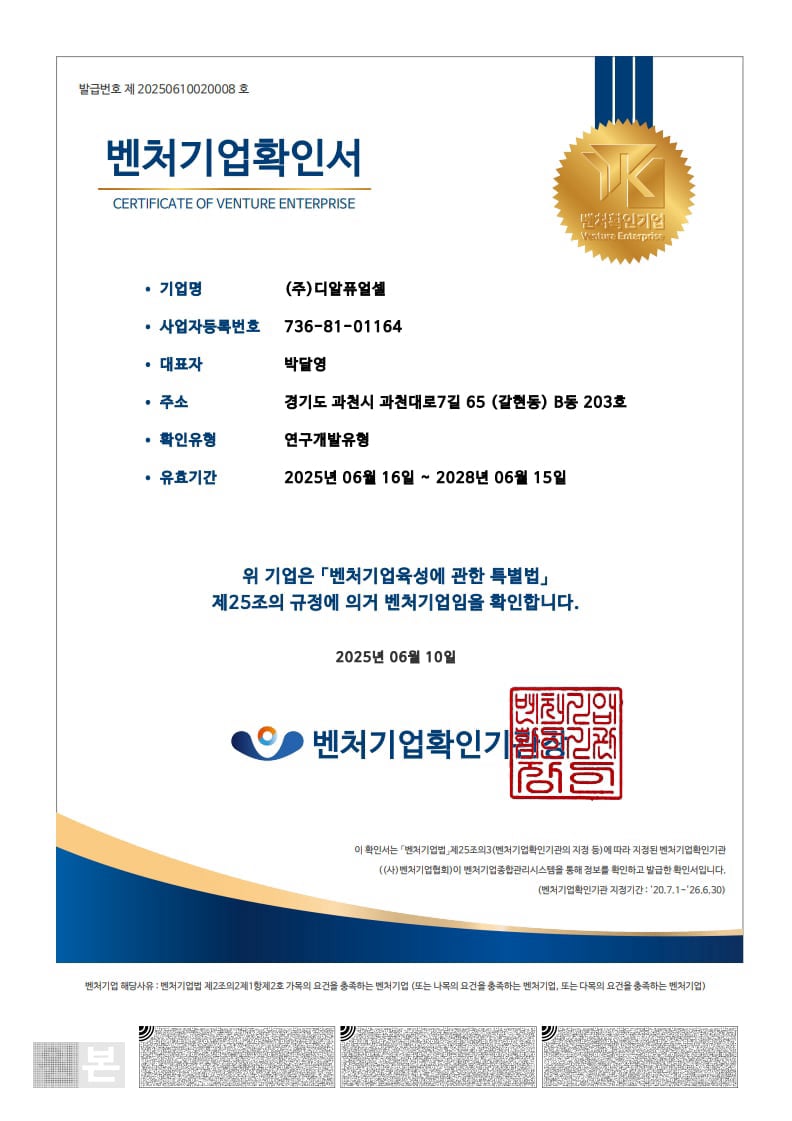
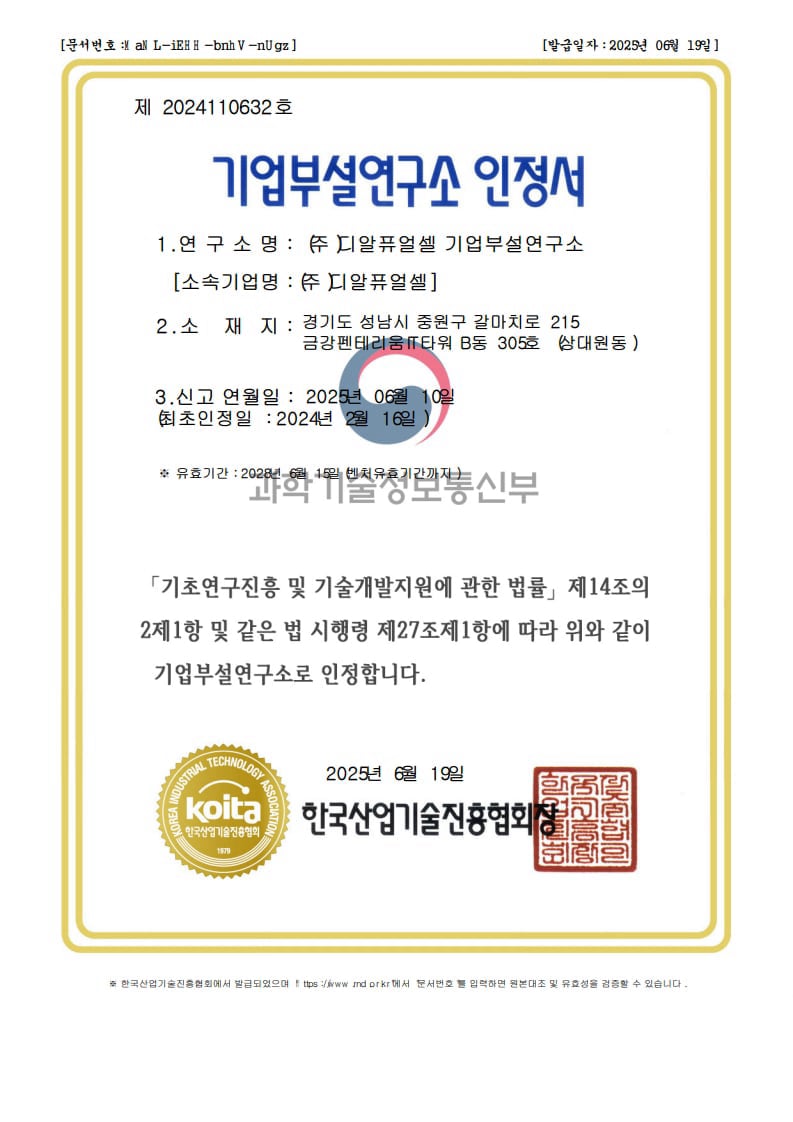
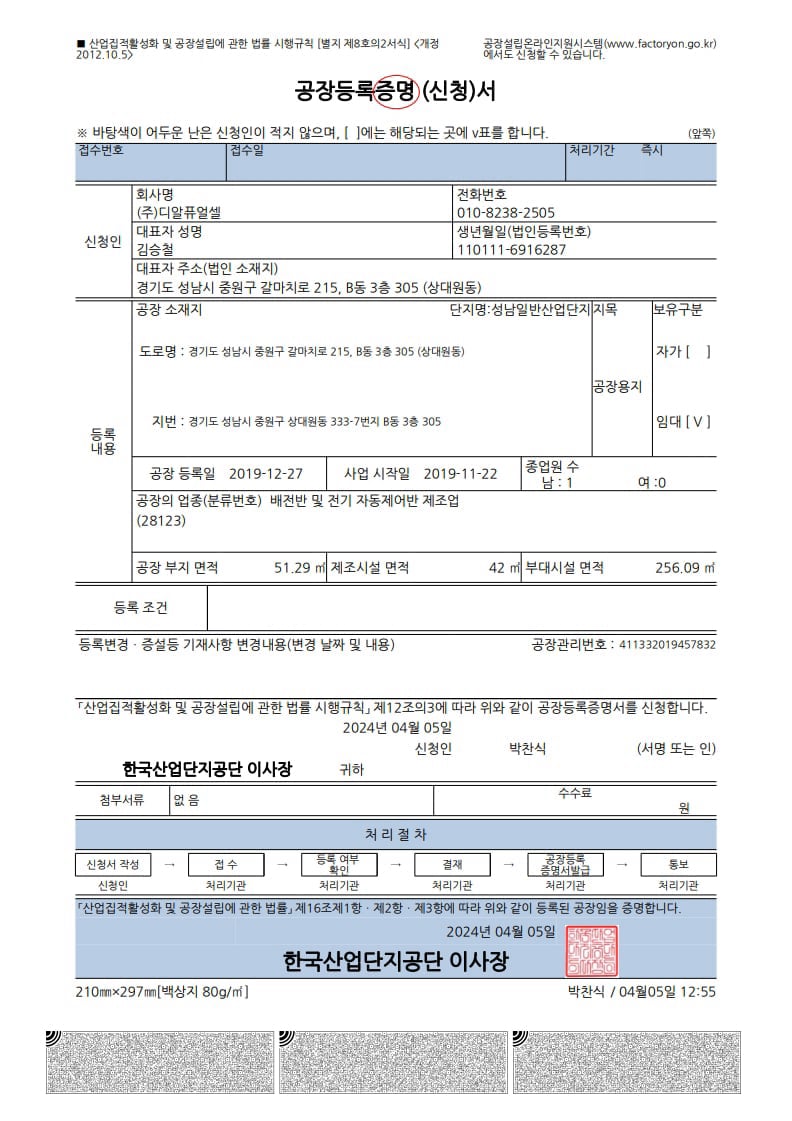
Certification
Domestic Patent Registrations
International Patent Registrations
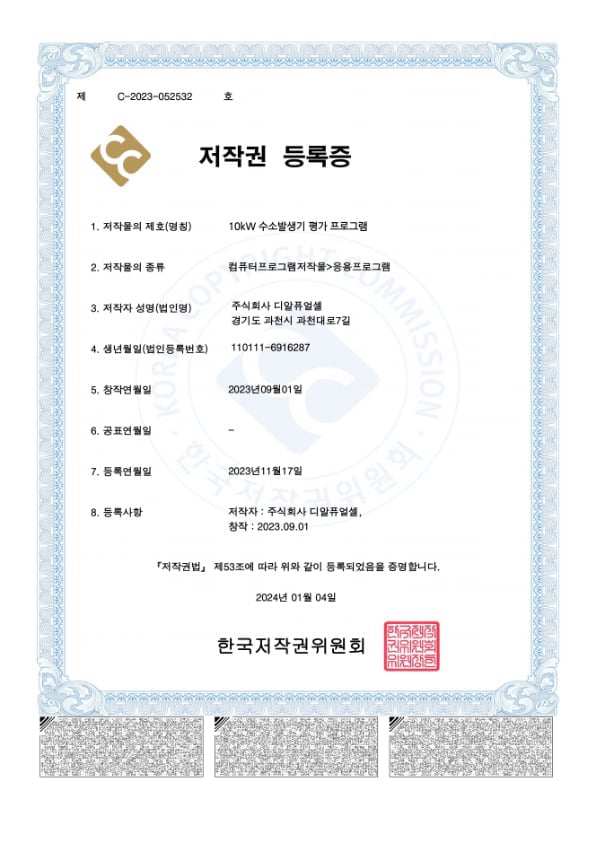
Copyright Registration Certificates
| Type | Patent Title | Country (Applicant) | Reg. No. (App. No.) | App. Date | Reg. Date | Remarks |
|---|---|---|---|---|---|---|
| Patent | Fuel Cell System | Korea (DR Fuel Cell) | 10-2022-0182159 | 2022.12.22 | Priority App., Awaiting Exam | |
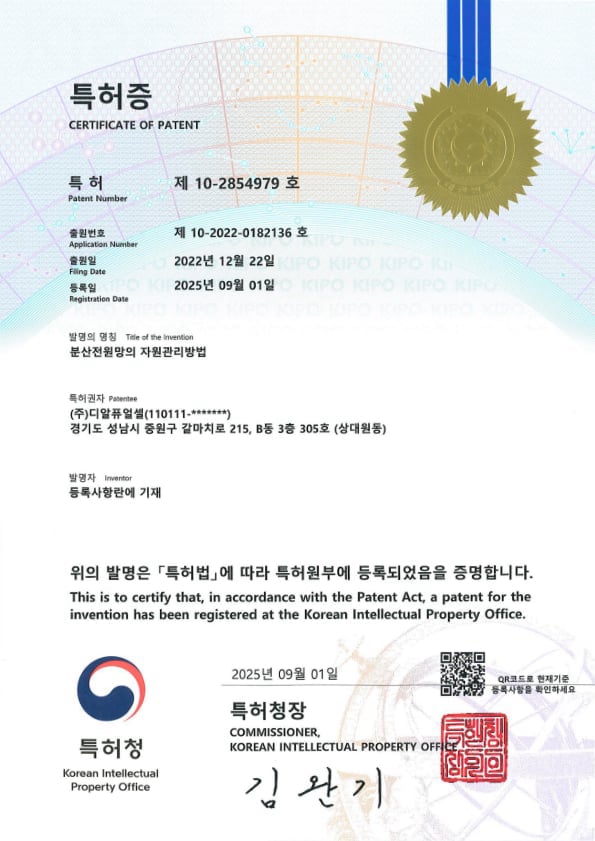
| Patent | Resource Management Method for Distributed Power Network | Korea (DR Fuel Cell) | 10-2022-0182136 | 2022.12.22 | Priority App., Awaiting Exam | |
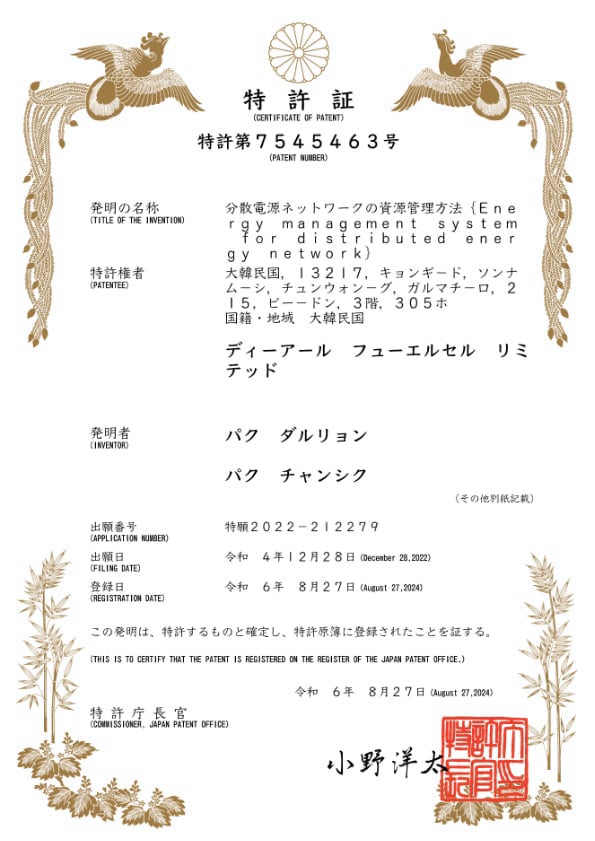
| Patent | Resource Management Method for Distributed Power Network | Japan (DR Fuel Cell) | 2022-212279 (2022-212279) | 2023.01.04 | 2024.08.27 | Unpublished |
| Patent | Efficiency Management Method for Stationary Fuel Cell System | Korea (Company A) | 10-1313880 (10-2012-0103045) | 2022.12.22 | 2013.09.25 | Tech License Agreement |
| Patent | Hydrogen Product by Simultaneous Reaction-Separation Process and Apparatus | Korea (Company A) | 10-1336764 (10-2011-0111015) | 2022.12.22 | 2013.11.28 | Transfer of Patent Right |
| Patent | Improved CO2 Capture Method Using Ammonia Aqueous Solution and Apparatus | Korea (Company A) | 10-1297210 (10-2011-0112523) | 2022.12.22 | 2013.08.09 | Transfer of Patent Right |
| App./Reg. Date | Patent Title | App./Reg. No. | Inventor | Patent Holder |
|---|---|---|---|---|
| 16.1.29 / '17.12.12 | Fuel Processor (USA) | US 9,839,898 B2 / 15/010,423 | Park Dal-young, et al. | KOGAS / CH Tech |
| '15.10.09 / '17.8.10 | Thermal Power Generation Device (Japan) | App. 2015-200961 | Park Dal-young, et al. | KOGAS / CH Tech |
| '15.2 / '17.8.18 | Fuel Processor | 10-2015-0023168 | Park Dal-young, et al. | KOGAS / CH Tech |
| '12.7.11 / '14.4.17 | Fuel Processor for Fuel Cells | 2012-0075737 / 10-1388788 | Park Dal-young et al. | KOGAS |
| '12.7.19 / '13.3.11 | Fuel Reformer Burner for Fuel Cell System | 2012-0078684 / 10-1244510 | Park Dal-young et al. | KOGAS |
| '13.11.19 / '15.7.6 | Fuel Reforming Burner | 10-2013-0140335 | Park Dal-young et al. | KOGAS / InnoN Co., Ltd. |
| '08.12.8 / '11.8.30 | Fuel Processing System | 2008-0123945 / 10-1062507 | Park Dal-young et al. | KOGAS |