Korea H2 Value Chain & Key Players


South Korea has established a complete hydrogen value chain spanning production, storage, transportation, and utilization. The production sector is led by SK E&S's world's largest liquid hydrogen plant and POSCO's green hydrogen initiatives, while storage and transportation are driven by Samsung Heavy Industries' LH2 carriers and Hyosung's liquid hydrogen storage tanks. Utilization has been diversified across mobility (Hyundai Motor Group), shipbuilding (HD Hyundai), power generation (Hanwha), and fuel cells (Doosan, S-Fuelcell). Mid-sized enterprises like Kolon Industries and Iljin Hysolus have achieved 99% localization of parts and materials, while Kwangshin Machine and Crios supply core equipment for charging infrastructure. It represents a fully equipped ecosystem with KRW 50 trillion in investments from seven major conglomerates and the participation of over 300 companies.

Korea Hydrogen Value Chain Flow & Key Players


Production → Storage → Transportation → Refueling → Application

4-3-1
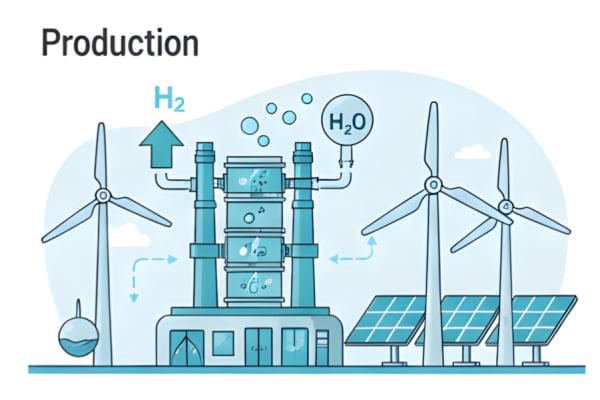
1. Production

Grey Hydrogen
• POSCO (70k tons/yr)
• Hyundai Oilbank (220k tons/yr)
• Natural Gas Reforming (SMR), By-product H2

Blue Hydrogen
• SK E&S Boryeong (250k tons/yr planned)
• POSCO (Target: 500k tons/yr)
• Combined with CCS Tech

Green Hydrogen
• Water Electrolysis
• POSCO Oman Project ($6.7B)
• Lotte H2biscus (150k tons/yr)
• Target: 5M tons by 2050

4-3-2
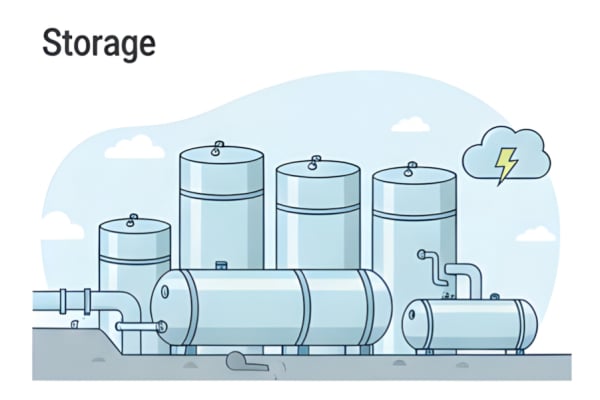
2. Storage

Liquid Hydrogen (LH2)
• Temp: -253℃ (Vol. reduced to 1/800)
• SK E&S Incheon (30k tons/yr)
• Hyosung Ulsan (39k tons/yr)
• Crios 4-ton Storage Tank

High-Pressure Gas
• Type IV Tank (Iljin Hysolus 700bar)
• 450bar Tube Trailer (373kg)

Alloy/Underground Storage
• Metal Hydride (Hydrolux 3.3wt%)
• Underground Rock Cavern (KIGAM Research)

4-3-3
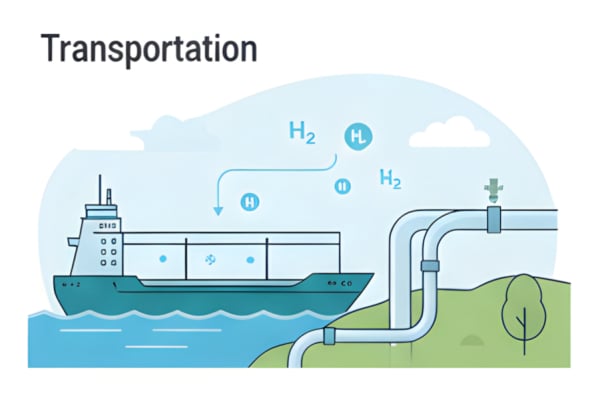
3. Transportation

Land Transport
• Tube Trailer (Type IV 450bar)
• LH2 Tank Trailer (D-Al 3-ton class)

Maritime Transport
• LH2 Carrier (HD Hyundai, commercialization by 2030)
• Ammonia Carrier (HD Hyundai 45,000㎥, Samsung Heavy Ind. 80,000㎥ design)

4-3-4
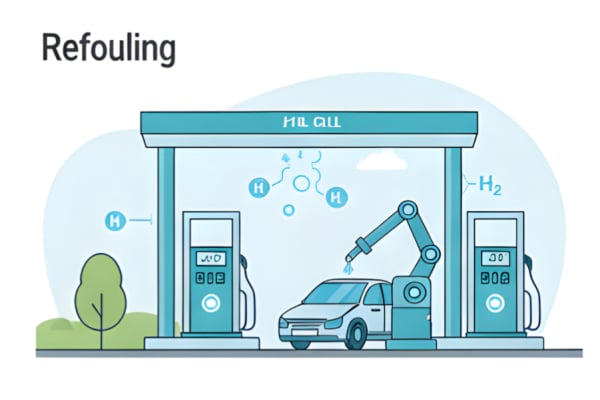
4. Refueling

Infrastructure (HRS)
• Current Status: 269 stations (420 units)
• Key Operators: HyNet, KOHYGEN, H2 Station, EnerHy

Key Equipment Manufacturers
• Compressor: Kwangshin Machine (54% share)
• Dispenser: MS Eng (70% localization)
• Storage Vessel: Iljin Hysolus (Type IV)

4-3-5
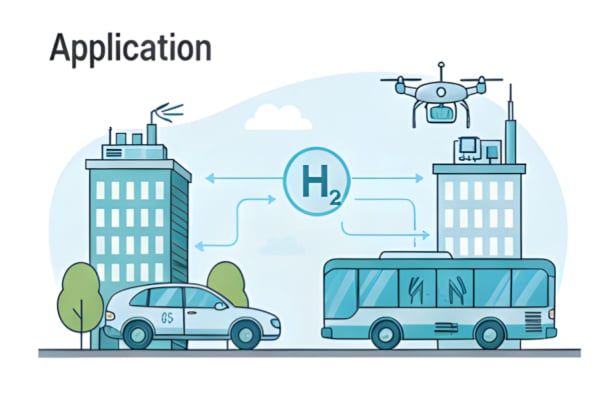
5. Application

Mobility
• Passenger: Hyundai NEXO (37,167 units)
• Commercial: Bus (1,234), Truck (Hyundai XCIENT 48)
• Future: Drone, UAM

Power Generation
• Fuel Cell: POSCO Energy (166.7MW), Bloom Energy SOFC (Eff. 53~65%)
• H2 Gas Turbine: Doosan (270MW), Hanwha (100% firing)

Industry & Buildings
• Industry: POSCO HyREX (H2 Reduction Steelmaking, First molten iron in Apr 2024)
• Building: S-Fuelcell (50% market share, 2030 target 2.1GW)

Korea Hydrogen Industry Value Chain 2025

1. Hydrogen Production: Establishing a 5 Million Ton System by 2050
1.1 Grey, Blue, and Green Hydrogen Production Strategy• Status and Expansion of By-product HydrogenPOSCO currently produces 7,000 tons of by-product hydrogen annually from the steelmaking process and plans to expand this to 70,000 tons by 2025. Hyundai Oilbank possesses a maximum annual production capacity of 300,000 tons of petrochemical by-product hydrogen, currently producing 220,000 tons. The SK E&S Incheon Liquid Hydrogen Plant has established a model to refine by-product hydrogen from SK Incheon Petrochem to produce 30,000 tons of liquid hydrogen annually.
• Full-scale Blue Hydrogen ProjectsSK E&S is constructing a blue hydrogen production plant near the Boryeong LNG Terminal with a target of 250,000 tons annually. By combining natural gas reforming with CCS (Carbon Capture and Storage) technology, it aims to build a large-scale blue hydrogen supply system by 2030. POSCO plans to complete a 500,000-ton blue hydrogen production system by 2030 in cooperation with global companies.
• Long-term Green Hydrogen StrategyPOSCO aims for a hydrogen production system of 2 million tons by 2040 and 5 million tons by 2050, promoting renewable energy-based green hydrogen projects. It participated in the Oman project in 2023 and signed an MOU with Orsted of Denmark for offshore wind-linked green hydrogen production. Lotte Group is pursuing the H2biscus Project (150,000 tons of green hydrogen, 850,000 tons of green ammonia annually) based on hydropower in Sarawak, Malaysia.

1.2 Water Electrolysis Technology Development StatusHyundai Motor Group is developing megawatt-class PEM water electrolysis devices and promoting price competitiveness through fuel cell component commonization. Hanwha Solutions is researching ways to lower power consumption and initial investment compared to existing methods by developing Anion Exchange Membrane Water Electrolysis (AEMWE) technology. The government has been fully supporting the construction of water electrolysis hydrogen production bases and blue hydrogen production bases since 2024.
Currently, the SMR (Steam Methane Reforming) method is the cheapest in terms of production cost per kg, but water electrolysis green hydrogen is expected to secure economic feasibility after 2040 due to the drop in renewable energy generation costs. The government has set a hydrogen price target of KRW 3,000 per kg by 2040.


2. Hydrogen Storage and Transportation: World's Largest Liquid Hydrogen Infrastructure
2.1 Leading Liquid Hydrogen Plants• SK E&S Incheon Liquid Hydrogen PlantIt is the world's largest single liquid hydrogen plant that began commercial operation in March 2024. It has an annual production capacity of 30,000 tons and liquefies hydrogen at a cryogenic temperature of -253°C to reduce its volume to 1/800. With a total investment of KRW 500 billion, this volume is enough to operate 5,000 hydrogen buses for a year. SK E&S is promoting the construction of 40 liquid hydrogen charging stations nationwide.
• Hyosung Heavy Industries Ulsan PlantHyosung Heavy Industries, in a joint venture with Linde, is constructing a liquid hydrogen plant in Ulsan with a phase 1 capacity of 13,000 tons per year (expanding to 39,000 tons in the future). Linde Hydrogen (production) and Hyosung Hydrogen (sales) share roles, with plans to build liquid hydrogen infrastructure at about 120 locations nationwide.

2.2 Diversification of Hydrogen Storage Technology • High-Pressure Gas Storage (Type IV Tank)Iljin Hysolus possesses Type IV tank manufacturing technology, which only two companies in the world, including Toyota, can produce. Vehicle tanks storing 2.1kg at 700bar pressure are exclusively supplied to Hyundai Motor's Nexo, with over 100,000 units already on the road. The Type IV tank for 450bar tube trailers stores 500kg, boasting 1.5 times higher transport efficiency than existing Type I tanks.
• Liquid Hydrogen Storage TankCrios developed a 1-ton liquid hydrogen storage tank as a national project, and its 4-ton storage tank boasts world-class insulation performance with a natural boil-off rate of 0.2%, four times superior to the industry average of 0.9%. D-Al developed the world's largest capacity 3-ton liquid hydrogen tank trailer, with a single transport volume equivalent to 12 trips of a gas hydrogen tube trailer.
• Metal HydrideHydrolux achieved a hydrogen storage capacity of 3.3wt% with Mg-based hybrid metal hydride. Operating at room temperature and low pressure of 10-40bar, it does not require high pressure and has excellent safety. It is applied to hydrogen scooters and forklifts and won an award at CES 2024.
• Underground Rock Cavern StorageThe Korea Institute of Geoscience and Mineral Resources (KIGAM) is researching rock cavern hydrogen storage technology utilizing Korea's granite terrain. They are developing ways to apply LNG underground storage experience (boil-off rate 0.01%/day) to hydrogen by designing steel pipe or cavern-type cavities at depths of tens to hundreds of meters underground. The Korea Institute of Civil Engineering and Building Technology is conducting research on underground space utilization with the goal of demonstrating an urban hydrogen supply base by 2026.


2.3 Innovation in Hydrogen Transport Infrastructure• Liquid Hydrogen CarrierHD Korea Shipbuilding & Offshore Engineering is developing technology with the goal of commercializing large liquid hydrogen carriers by 2030. The government, together with three Korean shipbuilders, is pursuing a roadmap to develop commercial liquid hydrogen carriers: a 2,000㎥ demonstration vessel by 2027, 40,000㎥ by 2032, and 160,000㎥ by 2040. Samsung Heavy Industries has obtained international certification for 20,000㎥ and 80,000㎥ designs.
• Ammonia CarrierHD Korea Shipbuilding & Offshore Engineering signed a contract for the world's first medium-sized ammonia DF (Dual Fuel) propulsion ship in March 2023, with delivery scheduled for 2025. It has since secured orders for a total of about 10 ships, establishing itself as a key means of reducing carbon emissions by over 90%.


3. Hydrogen Refueling Infrastructure: Building 660 Stations by 2030
3.1 Refueling Station Status (As of May 2025)269 stations (420 units) are in operation nationwide, with 37,167 hydrogen passenger cars, 2,107 hydrogen buses, and 39 hydrogen trucks registered. The average price is KRW 10,228/kg. By region, 72 stations have been built in Gyeongsang, 53 in Chungcheong, 45 in Gyeonggi, and 38 in Honam.
The government aims to build 450 stations by 2025, 660 by 2030 (including 280 liquid hydrogen stations), and 1,200 by 2040.

3.2 Major Construction and Operation Companies • SPV Operators HyNet (KOGAS + Hyundai Motor)
KOHYGEN (Hyundai Motor + KDHC + 8 private companies)
H2 Station (KOGAS + Samsung C&T)
EnerHy (SK Gas + Lotte Chemical + Air Liquide)
• Oil Refining Companies Hyundai Oilbank: Targeting 300 stations by 2040
SK E&S: 40 liquid hydrogen stations
GS Caltex: Integrated Energy Stations
3.3 Refueling Equipment Manufacturers Compressors: Kwangshin Machine (54% share), Bumhan Fuel Cell, GTC, Daeha, Korea Hydraulic
Dispensers: MS Eng (70% localization), Hyundai Rotem, J-Eng, Samjeong E&C
Storage Vessels: Iljin Hysolus (Type IV monopoly), NK (500bar/900bar localization)


4. Hydrogen Utilization: From Mobility to Power Generation and Industry
4.1 Mobility Revolution• Hydrogen Passenger CarsHyundai Nexo is capable of driving 400km with a 180kW fuel cell and ranks first with a global market share of 29.8%.
• Hydrogen BusesAs of September 2024, 1,234 units are in operation. Hyundai Motor produced 1,281 units, and HyAxiom Motors received certification in October 2024. The government aims to deploy 21,200 units by 2030.
• Hydrogen Trucks48 units of Hyundai XCIENT have accumulated 10 million km of driving in Switzerland, saving 6,300 tons of CO2. The goal is to introduce 1,600 units in Switzerland by 2025 and 25,000 units in Europe by 2030.
• MaritimeHD Korea Shipbuilding & Offshore Engineering is scheduled to deliver the world's first medium-sized ammonia DF propulsion ship in 2025, and the ammonia DF engine has received approval from 7 global classification societies.

4.2 Power Generation: Fuel Cells and Hydrogen Co-firing• Doosan EnerbilityDeveloped a 270MW gas turbine and succeeded in demonstrating 30% hydrogen co-firing. Currently developing 50% co-firing, aiming to complete a 400MW hydrogen firing turbine by 2027. A 900MW facility (KRW 4.5 trillion) is scheduled for completion in Dangjin by 2032.
• POSCO EnergySupplied 166.7MW of MCFC (Molten Carbonate Fuel Cell) facilities to about 20 locations, achieving 47% power generation efficiency and 80% cogeneration efficiency.
• Bloom Energy KoreaBoasts the industry's highest SOFC (Solid Oxide Fuel Cell) efficiency of 53-65%, ranking first with a global share of 44%. Completed the Gumi plant in 2023 and signed a contract for up to 1GW with AEP in the US in 2024.

4.3 Industry: POSCO HyREX Hydrogen Reduction Steelmaking• HyREX TechnologyAn innovative steelmaking process using 100% hydrogen based on FINEX. Successfully produced molten iron for the first time in the world in April 2024, reducing CO2 emissions to 400kg per ton, a 78% decrease compared to the traditional method's 1,850kg.
• Schedule2026: Pilot (300,000 tons/yr)
2030: Commercial Operation (1 million tons/yr)
2050: Full Transition (100%)
• POSCO GoalPresented a vision to achieve 5 million tons of hydrogen production and KRW 30 trillion in hydrogen revenue by 2050.

4.4 Buildings: Fuel Cells for Residential and Commercial Use• S-FuelcellHolds over 50% of the domestic market share and supplies 1-50kW PEMFCs. Achieved overall efficiency of over 85% and obtained Korea's first KS certification in 2016.
The government aims to deploy 2.1GW by 2030.
Korea's Hydrogen Economy Roadmap

Since announcing the world's first Hydrogen Economy Roadmap in 2019, South Korea has achieved remarkable results leading the global hydrogen economy over the past six years. This is evidenced by 'World's First' and 'World's Largest' achievements such as SK E&S's world-largest liquid hydrogen plant, POSCO's hydrogen reduction steelmaking, Hyundai Motor's Nexo ranking 1st globally, and Hanwha's hydrogen-fired gas turbine.

With investments exceeding KRW 50 trillion from seven major conglomerates, a complete value chain spanning production-storage-transportation-utilization has been established. The 99% localization rate of parts and materials demonstrates the technical prowess of mid-sized and small enterprises. While challenges such as securing clean hydrogen economic feasibility and expanding infrastructure remain, Korea possesses the world's most complete hydrogen ecosystem.

The vision of creating 27.9 million tons of demand, KRW 70 trillion in annual economic effects, and 600,000 jobs by 2050 is achievable through cooperation between the government and industry. Korea is leaping forward as a 'Hydrogen Leading Nation', simultaneously achieving energy independence and carbon neutrality through hydrogen.

NOW

2025 (Current)

• SK E&S Incheon Liquid Hydrogen Plant
• POSCO HyREX Molten Iron Production Success
• Opening of Clean Hydrogen Power Bidding Market

2030

Market Base Establishment

• H2 Vehicles: 850,000 units
• Refueling Stations: 660 units
• Fuel Cells: Over 8GW
• Hydrogen Demand: 3.9M tons

2040

Full-Scale Hydrogen Economy

• H2 Vehicles: 6.2M units
• Refueling Stations: 1,200 units
• Economic Effect: KRW 43T/year
• Jobs: 420,000

2050

Carbon Neutrality Completion

• H2 Demand: 27.9M tons (100% Clean)
• Economic Effect: KRW 70T/year
• Jobs: 600,000
• Final Energy Consumption: 21%

Major Companies and Institutions in the Korean Hydrogen Industry Ecosystem

Companies leading by-product hydrogen, blue hydrogen, green hydrogen production and water electrolysis technology development

POSCO
By-product Hydrogen: 7,000 tons annual production from steelmaking process, expanding to 70,000 tons by 2025
Blue Hydrogen: Establishing 500,000 tons production system by 2030
Green Hydrogen: 5 million tons production target by 2050, pursuing projects in Oman and Denmark
Goal: KRW 30 trillion hydrogen revenue by 2050
SK E&S
Blue Hydrogen: 250,000 tons annual production target at Boryeong LNG terminal
Liquefied Hydrogen: Operating world's largest liquefied hydrogen plant in Incheon (30,000 tons annually)
Refueling Infrastructure: Pursuing construction of 40 liquefied hydrogen refueling stations nationwide
Hyundai Oilbank
By-product Hydrogen: Maximum 300,000 tons annual production capacity at Yeosu (currently producing 220,000 tons)
Refueling Stations: 300 stations construction target by 2040
Lotte Group
Green Hydrogen: H2biscus project in Sarawak, Malaysia
Scale: 150,000 tons green hydrogen, 850,000 tons green ammonia annually
Hyundai Motor Group
Water Electrolysis: Megawatt-class PEM water electrolysis system development
Strategy: Securing price competitiveness through fuel cell component standardization
Hanwha Solutions
Water Electrolysis: Anion Exchange Membrane Water Electrolysis (AEMWE) technology development
Goal: Reduction in power consumption and initial investment
SK Incheon Petrochem
By-product Hydrogen: Supplying by-product hydrogen to SK E&S Incheon plant
Korea Gas Corporation (KOGAS)
Infrastructure: Operating LNG receiving terminals, hydrogen blending demonstration
Supply Chain: Expanding overseas clean hydrogen supply chain

Companies Building Hydrogen Storage & Transport Infrastructure (Liquid Hydrogen Plants, Storage Tanks, Carriers)

Hyosung Heavy Industries
Liquid Hydrogen: Joint venture with Linde, Construction of 13,000-ton/year plant in Ulsan
Expansion: Future expansion to 39,000 tons
Infrastructure: Plan to build liquid hydrogen infrastructure at approx. 120 locations nationwide
Linde
Joint Venture: Established Linde Hydrogen (Production 51%) and Hyosung Hydrogen (Sales 51%) with Hyosung Heavy Industries
Technology: Application of Cryo-pump Technology
Doosan Enerbility
Plant: 1,700-ton/year scale plant in Changwon (Operational in 2024)
Iljin Hysolus
Type IV Tank: One of only two global companies capable of production (along with Toyota)
Vehicle Use: 700bar, 2.1kg storage, Sole supplier for Hyundai NEXO (Over 100,000 units on road)
Tube Trailer: 450bar/525bar, 500kg storage, 1.5x efficiency compared to Type I
Cryos
Storage Tank: Developed 1-ton class national project, Demonstration at Changwon Daewon Station
4-ton Class: Natural evaporation rate 0.2% (4x better than industry average of 0.9%)
Tank Trailer: Developed 2.5-ton class (First in Korea), Preparing for KOSDAQ listing in 2025
DR (Deal)
Tank Trailer: World's largest capacity 3-ton liquid hydrogen tank trailer
Efficiency: One shipment equals 12 trips of a gaseous hydrogen tube trailer
Safety: Improved safety with transport pressure of 2~3bar
Hydrolux
Hydrogen Storage Alloy: Mg-based Hybrid Type (HL-2.0 Model)
Performance: Hydrogen storage capacity 3.3wt% (1.8x compared to existing 1.8wt%)
Features: Room temperature, 10~40bar low-pressure operation, Excellent safety
Applications: Hydrogen scooters, Hydrogen forklifts, CES 2024 Award Winner
HD Korea Shipbuilding&Offshore Engineering
Liquid H2 Carrier: Goal for large-scale commercialization by 2030
Roadmap: 2027: 2,000㎥ Demo Ship → 2032: 40,000㎥ → 2040: 160,000㎥
Ammonia Carrier: World's first medium Ammonia DF propulsion ship (45,000㎥) in 2023, Delivery in 2025
Orders: Approx. 10 ships total (Including 88,000㎥ class)
Samsung Heavy Industries
Liquid H2 Carrier: 20,000㎥ design ABS approved, 80,000㎥ design DNV approved (Sep 2024)
Samsung C&T
Storage Tank: World's largest 40,000㎥ liquid hydrogen storage tank technology (DNV Certified)
Capacity: 2,800 tons, Capable of charging over 500,000 hydrogen vehicles
NK
Storage Vessel: Localization of 500bar/900bar

Leading Companies in Hydrogen Application Sectors: Mobility, Power Generation, Industry, and Buildings

Hyundai Motor Company
NEXO: 180kW fuel cell, 400km range, Global market share 29.8% (1st)
Hydrogen Bus: 1,281 units produced
XCIENT: 48 units in Switzerland accumulated 10 million km, Reduced 6,300 tons of CO2
Goal: 1,600 units in Switzerland by 2025, 25,000 units in Europe by 2030
HyAxiom Motors
Hydrogen Bus: Certified in October 2024
Doosan Enerbility
Gas Turbine: Developed 270MW, Succeeded in 30% hydrogen co-firing, Developing 50%
100% Hydrogen Firing: Target to complete 400MW class turbine by 2027
Dangjin: 900MW (4.5 trillion KRW), Completion in 2032
POSCO Energy
MCFC: 166.7MW facilities (approx. 20 locations)
Efficiency: Power generation efficiency 47%, Combined heat and power 80%
Bloom Energy Korea
SOFC: Efficiency 53~65% (Industry highest), Global market share 44% (1st)
Gumi: Plant completed in 2023
Contract: Max 1GW with AEP (USA) in 2024
POSCO (POSCO HyREX)
Hydrogen Reduction Steelmaking: 100% hydrogen use based on FINEX
Achievement: World's first successful molten iron production in April 2024
CO2 Reduction: 400kg per ton (78% reduction compared to traditional method 1,850kg)
Roadmap: 2026 Pilot (300,000 tons) → 2030 Commercial Operation (1 million tons) → 2050 Full Conversion
S-Fuelcell
Residential/Building: Over 50% domestic market share
Products: 1~50kW PEMFC, Comprehensive efficiency over 85%
Certification: First in Korea to receive KS certification in 2016
Hydrogen Storage: Launched national project for hydrogen storage alloy forklift and charging facility development in August 2024
GS Caltex
Charging Station: Construction of integrated energy stations

Research Institutions for Hydrogen Tech R&D, Safety, and Standardization, and Charging Infrastructure Operators

Korea Institute of Energy Research (KIER)
Blue Hydrogen: Development of adsorbents and process technologies to reduce CO2 capture costs
Goal: Capture cost under $30 per ton
Korea Institute of Geoscience and Mineral Resources (KIGAM)
Rock Caverns: Research on underground hydrogen storage technology utilizing granite terrain
Technology: Design of steel pipe/cavern types at depths of tens to hundreds of meters underground
Korea Institute of Civil Engineering and Building Technology (KICT)
Demonstration: Demonstration of urban hydrogen supply bases by 2026
Research: Research on utilizing underground space
HyNet
Composition: KOGAS + Hyundai Motor Company
Role: Operation of Hydrogen Charging Station SPV
Kohygen
Composition: Hyundai Motor + KDHC + 8 Private Companies
Role: Operation of Hydrogen Charging Station SPV
HyStation
Composition: KOGAS + Samsung C&T
Role: Operation of Hydrogen Charging Station SPV
EnHy
Composition: SK Gas + Lotte Chemical + Air Liquide
Role: Operation of Hydrogen Charging Station SPV
Charging Equipment Manufacturers
Compressor: Kwangshin Machine Industry (54% share, 43 sites), Bumhan Fuel Cell, GTC, Daeha, Korea Hydraulic
Dispenser: MS ENG (Tatsuno partnership, 70% localization, 100 units), Hyundai Rotem, J.I. Engineering, Samjung E&C
DR Fuel Cell Co., Ltd.

Head Office: Rm. 203, Bldg. B, Gwacheon Sangsangzi Tower, 65 Gwacheon-daero 7-gil, Gwacheon-si, Gyeonggi-do, Korea
R&D Center / Plant: Rm. 305, Bldg. B, 215 Galmachi-ro, Jungwon-gu, Seongnam-si, Gyeonggi-do, Korea

E-mail: info@dr-fuelcell.com

Mission & Vision
  • A hydrogen generator developer with core technology essential for hydrogen supply in the hydrogen society. Leading the hydrogen industry through the development of multi-fuel hydrogen generators supporting natural gas, LPG, biogas, ammonia, e-methanol, and more.
  • Realizing clean hydrogen technology innovation through phased commercialization strategies-including supply to fuel cell system companies, entry into public procurement markets, and solutions for biogas plants and shipbuilders-combined with global R&D collaborations.