Korean Hydrogen Policy


South Korea's hydrogen policy is a pivotal national strategy designed to achieve the 2050 Carbon Neutrality goal, focusing on cultivating hydrogen as a primary energy source to replace coal and oil. As of 2025, the policy is centered on accelerating the establishment of a clean hydrogen ecosystem across production, distribution, and utilization.

The cornerstone of this policy is the creation of a large-scale hydrogen demand market through the implementation of the Clean Hydrogen Portfolio Standard (CHPS). To support this, Korea is accelerating domestic demonstration of Green and Blue hydrogen production technologies while actively pursuing overseas clean hydrogen import projects to secure a stable supply chain.

In terms of utilization, the key objectives include expanding mobility applications beyond passenger cars to commercial vehicles such as buses and trucks, and increasing the share of carbon-free power generation by applying hydrogen and ammonia co-firing technologies in power plants. Ultimately, by establishing core infrastructure such as a nationwide hydrogen pipeline network and securing technological competitiveness, South Korea aims to emerge as a 'First Mover' leading the global hydrogen economy. This policy embodies the nation's strong commitment to simultaneously achieving energy security and securing future growth engines.

1. Legal and Strategic Basis of Korea's Hydrogen Policy


1.1. Introduction: Policy Framework

South Korea's hydrogen policy has established a systematic legal and strategic framework through the enactment of the world's first Hydrogen Act and the establishment of long-term national implementation plans. This solid institutional foundation serves as a key cornerstone for securing policy consistency and predictability, reflecting the government's strong will to make the hydrogen economy a core means of national energy transition and a source of future industrial competitiveness. In particular, the clear legal basis and step-by-step implementation roadmap act as a basis of trust that attracts large-scale investment from the private sector and supports the sustainable growth of the industrial ecosystem.


1.2. Hydrogen Act: "Act on the Promotion of Hydrogen Economy and Hydrogen Safety Management"

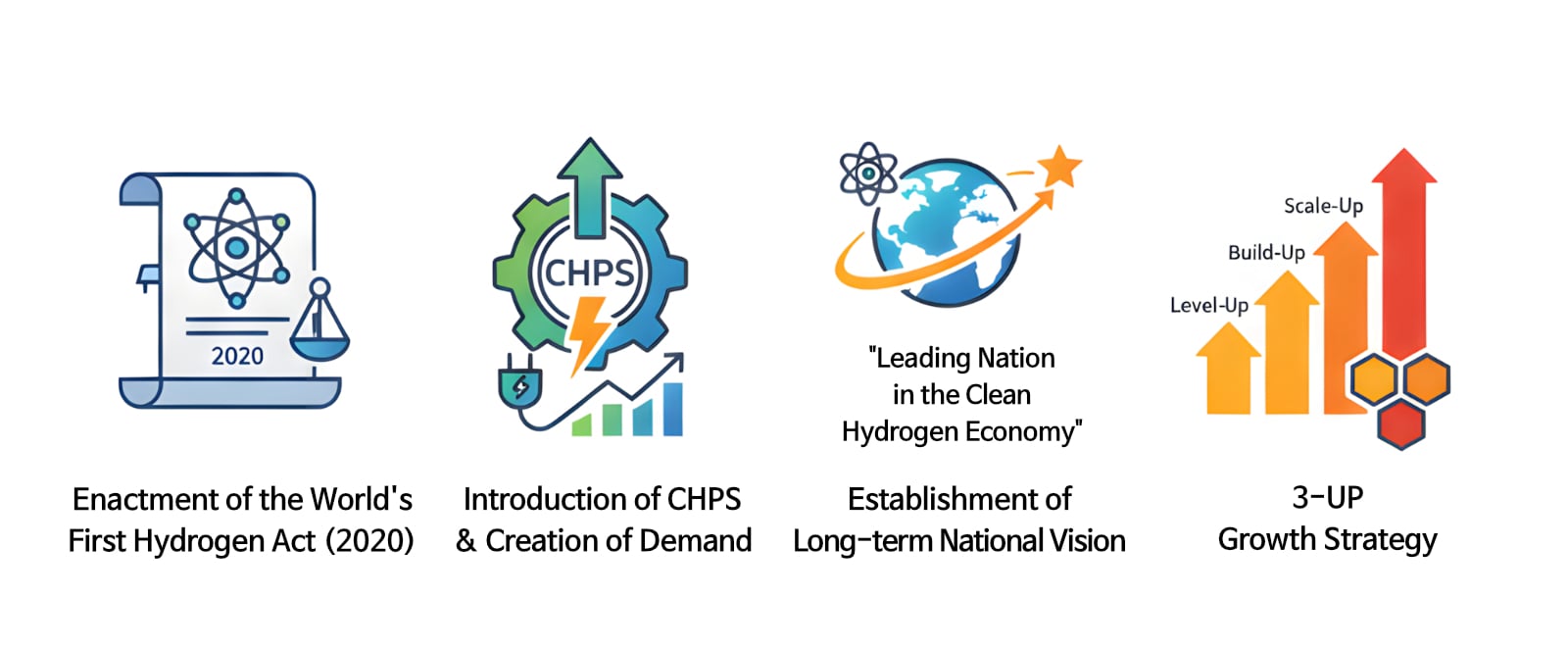
Enacted in 2020, the Hydrogen Act is the world's first specialized law laying the legal foundation for South Korea's hydrogen economy. It is a comprehensive legal mechanism that pursues both the systematic fostering of the hydrogen economy and safety assurance. It was further reinforced through a 2022 amendment that added legal grounds for the definition of clean hydrogen, the clean hydrogen certification system, and the Clean Hydrogen Portfolio Standard (CHPS).

  • Hydrogen Economy Committee: As a pan-governmental control tower chaired by the Prime Minister, it is the highest decision-making body that deliberates and coordinates major policies related to the hydrogen economy. This strengthens cooperation among ministries and ensures consistency and execution power in policy implementation.
  • Support for Specialized Hydrogen Enterprises: By specifying concrete support measures such as R&D subsidies, financial support, and tax benefits, the act actively promotes hydrogen technology development and commercialization. This plays a key role in building a healthy industrial ecosystem by nurturing SMEs and middle-market companies with innovative technologies.
  • Clean Hydrogen Portfolio Standard (CHPS): This is a system that mandates the use of clean hydrogen in the power generation sector, aiming to create a new market of 6,500 GWh annually. It functions as a key market mechanism to secure stable early hydrogen demand and accelerate decarbonization in the power generation sector.
  • Lifecycle Safety Management: Safety standards for facilities and infrastructure across the entire process—including hydrogen production, storage, transportation, and utilization—have been institutionalized. Strengthened safety regulations play a decisive role in ensuring public safety and increasing social acceptance, creating the prerequisites for the expansion of the hydrogen economy.

1.3. 1st Basic Plan for Implementation of the Hydrogen Economy (2021–Present)

Announced in November 2021, the 1st Basic Plan for Implementation of the Hydrogen Economy is the core roadmap of the current national hydrogen policy. This plan presents 15 tasks under 4 strategies with the goal of establishing a clean hydrogen-centered full-cycle ecosystem, containing specific execution paths for South Korea to leap forward as a 'First Mover in the Clean Hydrogen Economy'.

Key Goals:

  • Hydrogen Supply: Creating demand and supply of 3.9 million tons by 2030 and 27.9 million tons by 2050. Notably, Blue Hydrogen production will start with a 250,000-ton scale in Boryeong, Chungnam, for the first time in Korea in 2025, expanding to 750,000 tons by 2030 and 2 million tons by 2050.
  • Vehicle Deployment: Deploying 300,000 hydrogen vehicles (passenger cars, buses, trucks, etc.) by 2030. As of 2025, a total of KRW 721.8 billion in state funds is being supported for 2,000 hydrogen buses and 11,000 hydrogen passenger cars.
  • Hydrogen Refueling Stations: Expanding infrastructure to 450 stations by 2025 and 660 by 2030, ensuring convenient hydrogen charging nationwide.
  • Hydrogen Power Generation: Targeting 48 TWh by 2030 and 288 TWh by 2050, securing a stable demand base through the hydrogen power bidding market.
  • Hydrogen Price: Aiming for KRW 3,500 per kg by 2030 to secure economic feasibility and promote utilization.

4 Major Implementation Strategies:

  1. Leading Domestic and Overseas Clean Hydrogen Production: Establishing a stable supply chain by producing and importing clean hydrogen, such as Green and Blue hydrogen.
  2. Establishing Seamless Infrastructure: Systematically expanding infrastructure across the entire process from production to storage, transportation, and charging.
  3. Hydrogen Utilization in Daily Life: Expanding hydrogen use in all sectors including transportation, power generation, and industry so that hydrogen can be experienced in real life.
  4. Strengthening Ecosystem Foundation: Creating a sustainable hydrogen industry ecosystem through fostering specialized companies, technology development, workforce training, and international standardization.

1.4. Current Government Policy Direction: 3 UP Growth Strategy

The '3 UP Growth Strategy', announced at the 5th Hydrogen Economy Committee meeting in 2022, is an execution strategy that concretizes the 1st Basic Plan and intensively demonstrates the current government's hydrogen policy stance.

  • Scale-Up: Aims to expand the clean hydrogen-centered ecosystem domestically and internationally. Policy capabilities are focused on dramatically increasing the scale of the hydrogen economy by creating large-scale hydrogen demand and building global supply chains.
  • Build-Up: Secures efficiency and stability in hydrogen distribution by building core infrastructure such as world-class liquid hydrogen plants, ammonia receiving terminals, and nationwide hydrogen pipeline networks. In 2024, Korea's first liquid hydrogen plant began operation, and major ports nationwide are being overhauled to be suitable for hydrogen production, logistics, and consumption.
  • Level-Up: Aims to secure global technological leadership through advanced technology development and raise industrial competitiveness to the next level by fostering over 600 specialized hydrogen companies by 2030. Localization of core technologies and performance improvement are being pursued across all areas of hydrogen production, storage/transportation, and utilization.
khp01

2. Key Market Operation Systems for the Clean Hydrogen Economy


2.1. Introduction: Market-Based Clean Hydrogen Transition

The government is shifting its policy paradigm to build a sustainable ecosystem beyond the initial market formation of the hydrogen economy. Moving a step further from direct financial support or supply targets of the past, it has designed market mechanisms to induce the autonomous expansion of clean hydrogen production and consumption based on market principles. This holds strategic importance in securing the economic viability of clean hydrogen, resolving uncertainties in private investment, and laying the foundation for market growth without government intervention in the long term.


2.2. Clean Hydrogen Certification System (CH-Cert)

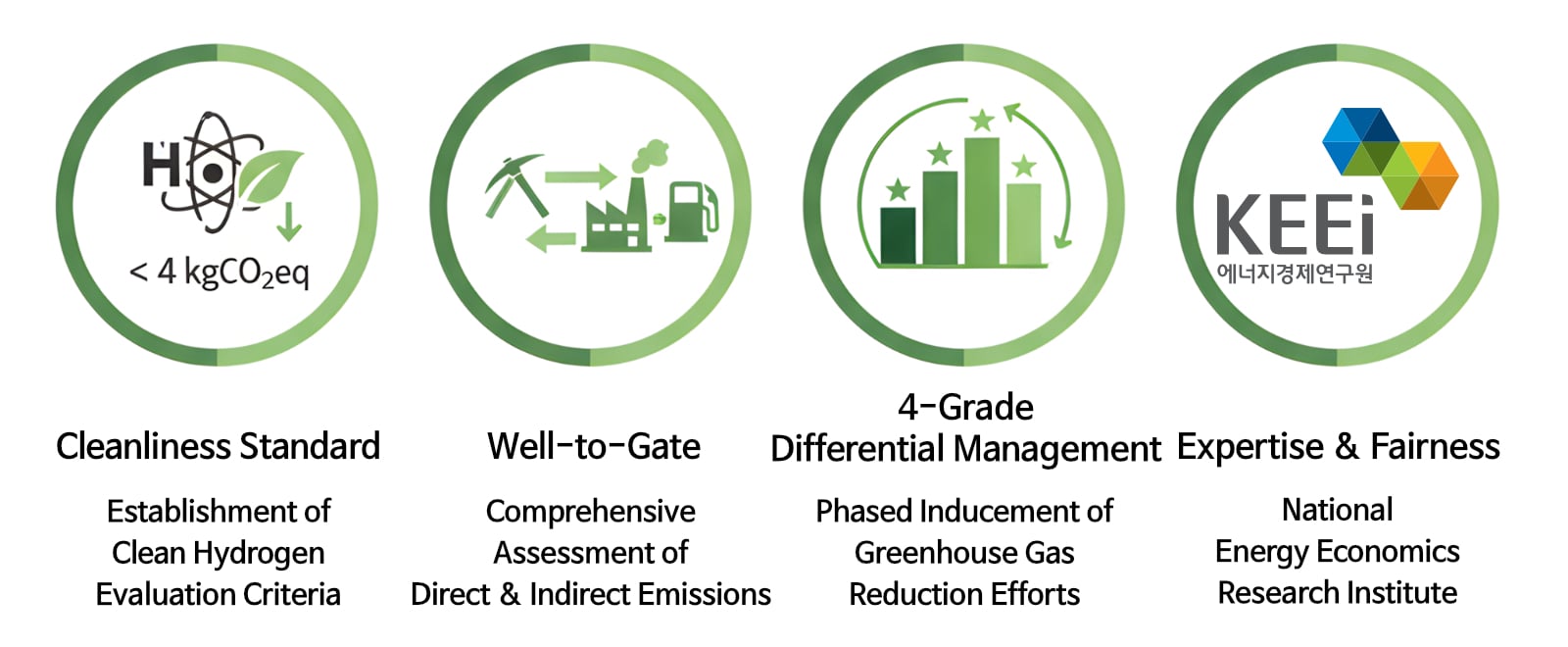
The Clean Hydrogen Certification System is a core institutional framework that objectively proves the 'cleanliness' of hydrogen based on greenhouse gas emissions generated during the production process. A pilot project began in March 2024, aiming for full implementation by 2027.

Certification Standards and Grading System:

  • Certification Standard: Hydrogen is certified as clean hydrogen if greenhouse gas emissions during the production of 1kg of hydrogen are 4 kgCO₂eq (carbon dioxide equivalent) or less. This reflects a comprehensive consideration of international trends and domestic technological levels, aligning with standards in major countries such as the US (4kg), EU (3.38kg), and Japan (3.4kg).
  • Grading System: To induce phased efforts for greenhouse gas reduction, clean hydrogen is managed in four grades based on emission levels.
    • Grade 1: 0 ~ 0.1 kgCO₂eq/kgH₂
    • Grade 2: 0.1 ~ 1 kgCO₂eq/kgH₂
    • Grade 3: 1 ~ 2 kgCO₂eq/kgH₂
    • Grade 4: 2 ~ 4 kgCO₂eq/kgH₂

Evaluation Scope and Operation:

  • Evaluation Scope: The evaluation applies a 'Well-to-Gate' approach, covering the entire process from raw material extraction to hydrogen production. This comprehensive assessment includes direct emissions (Scope 1), indirect emissions from electricity and heat used in production (Scope 2), and other indirect emissions from the raw material supply chain (Scope 3). However, considering the unique domestic situation where overseas clean hydrogen imports are inevitable, ship emissions are temporarily excluded.
  • Operating Agencies: In December 2023, the Ministry of Trade, Industry and Energy officially designated the Korea Energy Economics Institute (KEEI) as the certification operating agency, and the Korea Testing Certification (KTC) and Korea Testing & Research Institute (KTR) as certification testing and evaluation agencies, ensuring the expertise and fairness of the system.
  • Certification Information System: In 2025, the establishment of the Clean Hydrogen Certification Information System will commence. This integrated platform will handle the entire process online, from facility verification and certification application to certificate issuance and registration, enabling tracking of certificates at each stage including production, import, sales, and cancellation.
khp02

2.3. Clean Hydrogen Portfolio Standard (CHPS) Bidding Market

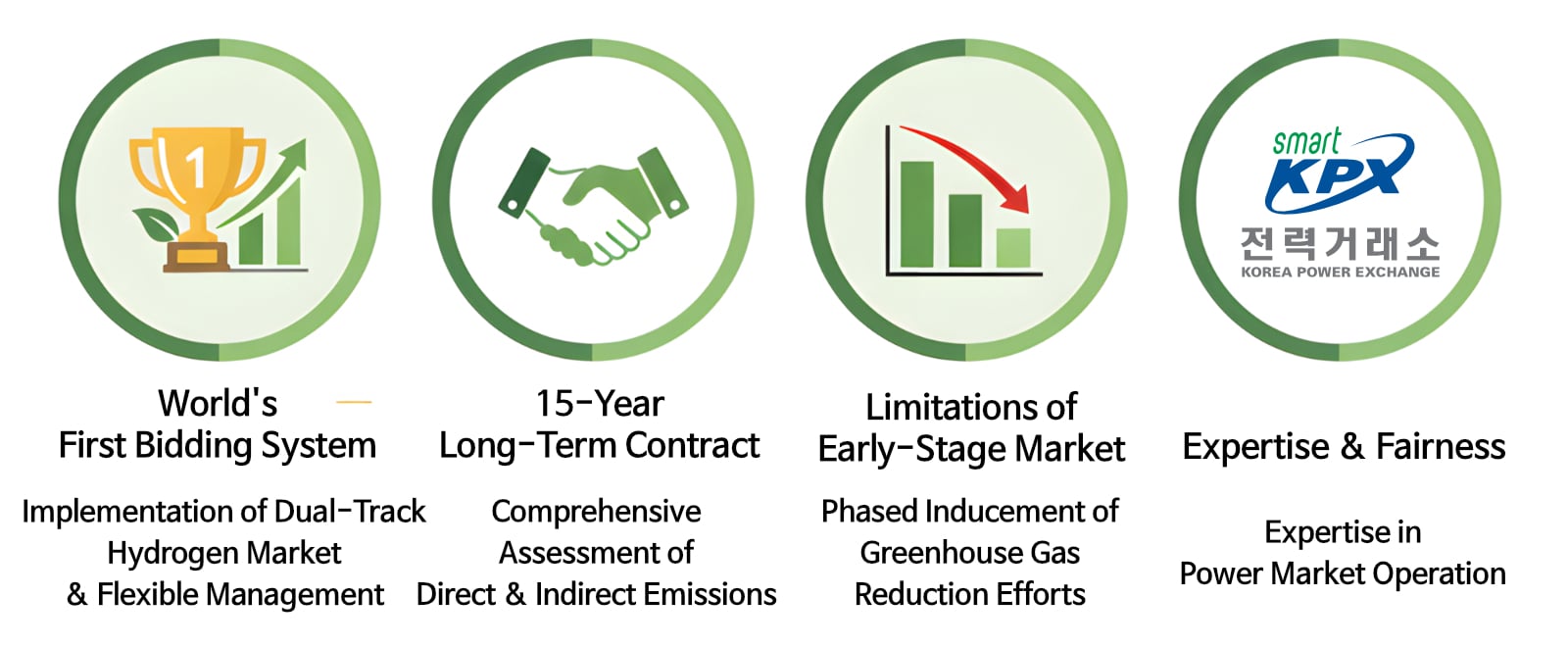
To secure a stable demand source for certified clean hydrogen and promote decarbonization in the power generation sector, the world's first Clean Hydrogen Portfolio Standard (CHPS) bidding market was opened in May 2024.

Market Structure and Operation:

  • Market Segmentation: The market operates in two segments. It is dualized into a General Hydrogen Power Generation Market utilizing existing by-product hydrogen and extracted hydrogen, and a Clean Hydrogen Power Generation Market that mandates the use of certified clean hydrogen fuel, allowing for flexible management according to policy goals.
  • Contract Conditions: Winning power generation operators are designed to sign a 15-year long-term fixed-price contract. This aims to ensure operators can predict stable long-term revenue and manage investment risks, considering the nature of power generation projects involving large-scale investments.

2024 First Bidding Results and Challenges:

  • Bidding Results: In the first bidding of 2024, only 11.5% (750 GWh) of the annual target volume of 6,500 GWh was awarded. Korea Southern Power's Samcheok Green Power Unit 1 was selected as the sole preferred bidder, with the winning bid price reported to be around KRW 470 per kWh.
  • Causes of Low Participation: Major causes are analyzed as high import prices of overseas clean hydrogen, lack of infrastructure, exchange rate risks, and the gap between the government's bid price cap (KRW 450–500 range) and most operators' bid prices (KRW 500–600 range). In particular, the structure where operators solely bear the risk of exchange rate fluctuations over the 15-year contract period, as the clean hydrogen power market is settled in dollars, is estimated to have raised bid prices by up to 20%.

2025 Bidding and System Improvements:

  • Volume Adjustment: In May 2025, the second clean hydrogen power generation market bidding was announced, with the opening volume reduced to 3,000 GWh, half of the previous year. Including the 5,750 GWh carried over from 2024, the total volume is 8,750 GWh.
  • System Improvements: Major improvement measures were introduced to alleviate initial market uncertainties.
    • Exchange Rate-Linked Settlement System: The exchange rate-linked power generation unit price reflects the exchange rate at the time of settlement, mitigating business risks due to exchange rate fluctuations. This is expected to reduce the total power generation unit price by 9–10%, lowering it to the KRW 430–450 per kWh range.
    • Volume Borrowing System: To increase flexibility in the process of fuel volume consumption, a borrowing system was added in addition to the existing volume carryover.
  • Management Entity: The Korea Power Exchange (KPX), possessing expertise in power market operation, oversees the opening and operation of the bidding market. In January 2023, KPX was officially designated as the management agency for the hydrogen power generation bidding market.
khp03

3. Hydrogen Economy Implementation Policies by Sector


3.1. Introduction: Spreading Hydrogen Utilization Across Industries

The success of hydrogen economy policies is not limited to achievements in specific fields. Synergy can only be created when the entire value chain—from clean hydrogen production to transportation, power generation, and industry—is organically connected. The government is concretizing its strategy by promoting customized policies across key economic sectors, including production & supply, mobility, and power generation, so that each sector grows in a mutually complementary manner and drives the spread of the overall hydrogen economy.

3.2. Production and Supply: Clean Hydrogen Self-Sufficiency and Supply Chain Construction

To ensure a stable hydrogen supply, the government is strengthening domestic clean hydrogen production capabilities while simultaneously building a global supply chain for economically viable overseas hydrogen imports. The specific goals for 2030 and 2050 are as follows:

  • Total Supply: 3.9 million tons by 2030, 27.9 million tons by 2050.
  • Domestic Production: 1.94 million tons by 2030 (including 250,000 tons of Green Hydrogen and 750,000 tons of Blue Hydrogen).
  • Overseas Import Volume: 1.96 million tons by 2030, 22.9 million tons by 2050.

3.3. Transportation (Mobility): Expansion Centered on Commercial Vehicles

Hydrogen mobility policy is strategically shifting from passenger cars in the early stages to commercial vehicles such as buses and trucks, which have significant effects on creating large-scale hydrogen demand and reducing greenhouse gases.

  • Deployment Goal: Aiming to deploy 300,000 hydrogen vehicles by 2030 and build 660 hydrogen refueling stations nationwide to support them.
  • 2025 Subsidy Policy: The government has allocated a budget of KRW 721.8 billion to support hydrogen vehicle purchases, targeting the deployment of 11,000 hydrogen passenger cars and 2,000 buses.
    • Passenger Cars: Subsidies of up to KRW 35 million (state + local funds).
    • Buses: Support of up to KRW 350 million depending on vehicle type, with preferential treatment for high-performance vehicles through a performance-based evaluation system.
    • Policy Risk: However, concerns about policy consistency have been raised as the budget related to hydrogen vehicles is expected to be cut by approximately KRW 145 billion in the 2026 budget plan.
  • Infrastructure Expansion: Expanding liquid hydrogen refueling stations capable of large-capacity charging to 280 locations, alongside gas refueling stations. The plan is to dramatically improve accessibility so that stations are located within 20 minutes in major cities and within 75 km on expressways. However, securing a sustainable operating model remains an urgent task, as economic analysis (B/C ratio) shows less than 1.0 (0.8882) and average deficits are occurring.

3.4. Power Generation: Roadmap for Carbon-Free Power Transition

The power generation sector aims to convert existing fossil fuel power generation facilities to eco-friendly energy sources using hydrogen and ammonia. The roadmap for phased technology demonstration and commercialization is as follows:

  • Ammonia Power Generation: Ammonia has the advantage of utilizing existing coal power infrastructure. The government plans to complete the demonstration of 20% coal-ammonia co-firing technology by 2027 and commercialize and apply it to more than half of the total domestic coal power plants by 2030.
  • Hydrogen Power Generation: Aims to convert gas turbines using LNG as fuel to hydrogen turbines. The plan is to complete the demonstration of 50% hydrogen co-firing in 150MW-class large-capacity gas turbines by 2028, and in the long term, commercialize 30~100% co-firing or 100% hydrogen firing by 2040 to serve as a key pillar of carbon-free power generation.

4. Infrastructure Establishment and Safety Management Policy


4.1. Introduction: Securing the Physical Foundation and Social Acceptance

The systematic construction of large-scale hydrogen infrastructure acts like the 'blood vessels' connecting the production, distribution, and utilization of clean hydrogen. This is a prerequisite for solidifying the physical foundation of the hydrogen economy while realizing economies of scale. Furthermore, the hydrogen economy cannot take root without public trust. Therefore, learning from past accidents to establish a preemptive and systematic safety management system, thereby proving technological safety and securing social acceptance, is a strategic task as important as infrastructure construction itself.

4.2. Core Hub Infrastructure: Hydrogen Specialized Complexes and Hydrogen Cities

The government is promoting policies for specialized complexes and hydrogen cities to maximize the clustering effect of the hydrogen industry and spread models utilizing hydrogen as an urban energy source.

  • Hydrogen Specialized Complexes: A policy to create clusters where the full-cycle industry from hydrogen production to utilization is integrated. In 2024, Donghae/Samcheok, Gangwon (Liquid Hydrogen Storage/Transportation) and Pohang, Gyeongbuk (Fuel Cells for Power Generation) were designated as Korea's first hydrogen specialized complexes. Comprehensive support for technology development, attracting companies, and workforce training is provided to these regions, and a public contest for new complex designations is underway in 2025.
  • Hydrogen City 2.0 Strategy: Based on the achievements of existing pilot city projects, the expanded 'Hydrogen City 2.0' strategy is being promoted. This aims to expand hydrogen utilization beyond limited sectors like housing and transport to all urban components including industry, buildings, and power generation. Furthermore, it plans to realize true clean energy cities by moving away from living zone-based gray hydrogen use to supplying blue and green hydrogen from regional hubs.

4.3. Supply Chain Infrastructure: Construction of Production Bases and Pipeline Networks

To respond to nationwide hydrogen demand, the construction of hub-type production bases and pipeline networks is proceeding in parallel. Hub-type hydrogen production bases have been built in places like Gwangju (1,400 tons/yr) and Changwon (3,650 tons/yr), and SK E&S has completed the world's largest (30,000 tons/yr) liquid hydrogen plant in Incheon. However, the 'Valley of Death' phenomenon—an imbalance between ambitious supply infrastructure and an immature demand market—is becoming a reality, evidenced by delays in the commercial operation of HyChangwon, Korea's first commercial liquid hydrogen plant due to initial lack of demand. Meanwhile, construction of a 16km hydrogen pipeline in Pyeongtaek, connecting the metropolitan area and the Chungcheong region, is scheduled to start in October 2025 and be completed by January 2028.

4.4. Strengthening Safety Management System: Hydrogen Safety Management Roadmap 2.0

Following incidents such as the Gangneung hydrogen tank explosion in 2019 and the Chungju hydrogen bus explosion in 2024, the government established the 'Hydrogen Safety Management Roadmap 2.0' to build a global-level safety management system. The Korea Gas Safety Corporation (KGS) under the Ministry of Trade, Industry and Energy serves as the dedicated agency, promoting policies centered on the following three strategies:

  • Preemptive Safety Standards for Clean Hydrogen Ecosystem: Preemptively developing safety standards (KGS Codes) for new forms of hydrogen energy sources such as ammonia and liquid hydrogen, as well as new technologies like electrolysis facilities and hydrogen turbines, while aligning them with international standards.
  • Regulatory Innovation to Foster World-Class Industry: Supporting the growth of the hydrogen industry by reasonably improving regulations related to the location of urban charging stations and self-service charging within the scope of ensured safety.
  • Balanced Safety Management Approach: Securing both efficiency and effectiveness of safety management through a balanced approach that enhances the autonomous safety management capabilities of operators while strengthening government supervision over high-risk facilities.

5. Technology Innovation and Global Cooperation Strategy


5.1. Introduction: R&D and International Partnerships for Future Competitiveness

The long-term success and market preemption of the hydrogen economy depend on the internalization of core technologies and the securing of a stable overseas supply chain. Developing domestic technology is essential to break free from technological dependence and secure price competitiveness. At the same time, as domestic production alone has clear limitations, establishing international partnerships to stably procure economically viable clean hydrogen is urgent. The government is creating synergy through a two-track strategy: increasing technological self-sufficiency through national R&D support and diversifying supply chains through strategic international cooperation.

5.2. Core Technology Development Strategy

The government is concentrating R&D support on key technology areas that will lead the future hydrogen market through initiatives such as the '5th Energy Technology Development Plan'.

  • Water Electrolysis Technology: Localization of water electrolysis technology, the core of green hydrogen production, is the top priority. R&D is underway to improve the efficiency of various water electrolysis technologies such as Polymer Electrolyte Membrane (PEM), Alkaline (AEC), and Solid Oxide (SOEC), and to secure self-sufficiency in core materials and components.
  • Storage and Transportation Technology: Focusing on technology development for long-distance transportation of large-scale hydrogen. Based on the experience of operating the world's largest liquid hydrogen plant, the goal is to localize related core equipment such as liquid hydrogen carriers and large hydrogen turbines.
  • Utilization Technology: Supporting technology development to maximize hydrogen utilization in industrial and power generation sectors. Efforts are focused on accelerating the commercialization of Hydrogen Reduction Steelmaking (HyREX) technology for carbon neutrality in the steel industry and improving the efficiency and durability of next-generation fuel cells for buildings and power generation.

5.3. International Cooperation for Securing Global Hydrogen Supply Chain

The government is building a stable clean hydrogen supply chain by strengthening bilateral cooperation with major resource-holding countries and technology leaders.

  • Japan: Regularized hydrogen policy and technology exchange through the 1st Korea-Japan Hydrogen Cooperation Dialogue. Both countries have formed working groups in three areas: mutual recognition of clean hydrogen certification, harmonization of mobility standards, and cooperation on safety standards, discussing concrete cooperation measures.
  • Saudi Arabia: Signed the 'Korea-Saudi Hydrogen Oasis Cooperation Initiative' to fully launch cooperation for the domestic introduction of blue ammonia, combining Saudi Arabia's low-cost fossil fuels with carbon capture technology.
  • Australia: Promoting green hydrogen imports utilizing Australia's abundant renewable energy based on the 'Low Emissions Technology Partnership'. Along with this, multilateral cooperation is underway, including sharing experiences in hydrogen vehicle deployment and infrastructure construction between the two countries.
  • United States: Within the framework of the 'Korea-US Advanced Industry and Clean Energy Partnership', we are strengthening technological alliances by promoting joint R&D and demonstration projects for next-generation hydrogen production and utilization technologies.

Key Domestic Policy Agencies

Key policy agencies responsible for system design, legislation, national strategy establishment, and inter-ministerial coordination.

1. Ministry of Climate, Energy and Environment
Role: Integrated control tower ministry established in 2025, managing energy policies (formerly MOTIE) and climate policies (formerly ME).
Function: Overseeing national energy transition, GHG reduction, and clean hydrogen policies. Establishing standards for Clean Hydrogen Power Generation (CHPS) and hydrogen emission regulations.
Visit Official Website
2. Ministry of Trade, Industry and Energy (MOTIE)
Role: General oversight of hydrogen economy master plans and legislation/revision of laws.
Function: Designation of Hydrogen Specialized Complexes, operation of Clean Hydrogen Certification System, and promotion of hydrogen industry (R&D for parts/materials, demonstration projects).
Affiliated Agency: Execution of R&D and budget allocation via KETEP.
Visit Official Website
3. Hydrogen Economy Committee
Role: The highest decision-making body and official governmental coordinating body for the hydrogen economy.
Composition: Prime Minister (Chair), Minister of MOTIE (Secretary), Ministers of key ministries (MOEF, MSIT, ME, MOLIT), and private experts/industry representatives.
Function: Deliberation and coordination of pan-government hydrogen strategies, approval of Hydrogen Act implementation plans, and deliberation on specialized complexes and clean hydrogen systems.
View Details

Specialized agencies responsible for research, verification, and safety management of clean hydrogen production, storage, and transportation technologies.

1. Korea Institute of Energy Technology Evaluation and Planning (KETEP)
Role: Agency responsible for planning, evaluating, and budget execution of Hydrogen R&D projects.
Function: Supporting research on water electrolysis, fuel cells, storage/transportation technologies, and evaluating technology commercialization.
Visit Official Website
2. Korea Institute of Energy Research (KIER)
Role: Government-funded research institute leading clean hydrogen production and electrolysis technology development.
Function: Demonstration of Green/Blue hydrogen production technologies and research on catalysts and electrolyte materials.
Visit Official Website
3. Korea Gas Safety Corporation (KGS)
Role: Supervising agency for safety inspection and certification of hydrogen facilities and charging stations.
Function: Management of technical standards and inspection systems for hydrogen high-pressure gas storage, transportation, and charging facilities.
Visit Official Website
4. Korea Gas Corporation (KOGAS)
Role: Leading agency revitalizing the hydrogen economy through the construction of hydrogen production and supply infrastructure.
Function: Operation of LNG terminals, demonstration of hydrogen blending, and expansion of overseas clean hydrogen supply chains.
Visit Official Website

Executing agencies responsible for industry promotion, technology commercialization, clean hydrogen market operation, corporate support, and global cooperation.

1. Korea Power Exchange (KPX)
Role: Operator and settlement entity for the Clean Hydrogen Portfolio Standard (CHPS) bidding market.
Function: Selection of power generation operators, calculation of winning bid prices, contract monitoring, and management of clean hydrogen power generation ratios.
Visit Official Website
2. Korea Energy Agency (KEA)
Role: Agency promoting pilot projects related to hydrogen distribution and efficiency.
Function: Operation of clean hydrogen distribution platform, hydrogen industry statistics and demand management, and execution of private supply support projects.
Visit Official Website
3. H2KOREA (Hydrogen Convergence Alliance)
Nature: Public-private partnership non-profit organization (Incorporated Association).
Role: Policy-industry bridge as a hydrogen industry consultative body, central axis for private enterprise support and global cooperation.
Function: Fostering specialized hydrogen companies, hosting international exhibitions (e.g., H2 WORLD), public promotion of hydrogen economy, and standardization support.
Visit Official Website
4. Korea Hydrogen Industry Association (KHIA)
Role: Industry-centered consultative body responsible for joint responses and policy proposals for domestic hydrogen companies.
Function: Hydrogen corporate support projects, technical standard consultations, and operation of global cooperation networks (GHIAA).
Visit Official Website

Regional executing agencies promoting region-based hydrogen economy ecosystem creation and infrastructure projects.

1. Korea Hydro & Nuclear Power (KHNP)
Role: Nuclear and hydro-centered energy company leading the establishment of hydrogen convergence power generation and production bases.
Function: Development of hydrogen production and storage technologies, operation of fuel cell power generation systems, and creation of large-scale hydrogen infrastructure.
Visit Official Website
2. Local Governments (Metropolitan/Basic)
Role: Leading the cultivation of regional hydrogen industries and the creation of Hydrogen Specialized Complexes and Hydrogen Cities.
Function: Construction of region-specific hydrogen infrastructure and support for hydrogen industry cluster formation.
3. Local Public Enterprises & Industrial Complex Corps
Role: Responsible for the construction and operation of hydrogen charging stations, production, and storage infrastructure.
Function: Establishment of hydrogen supply chains within industrial complexes, safety management of charging stations, and maintenance.

Key Official Documents on Hydrogen Policy

Legal basis for hydrogen policy including the Hydrogen Economy Promotion Act, its Enforcement Decree, and Enforcement Rules.

Hydrogen Economy Promotion and Hydrogen Safety Management Act
National Law Information Center
The fundamental law for fostering the hydrogen economy and managing safety. Defines the legal framework for industry promotion, specialized complexes, and safety management systems.
View Original Act
Enforcement Decree of the Hydrogen Economy Act
National Law Information Center
Specifies detailed implementation matters of the Act. Details procedures for designating specialized complexes, operation of the Hydrogen Economy Committee, and clean hydrogen standards.
View Decree
Enforcement Rule of the Hydrogen Economy Act (Revised May 29, 2025)
National Law Information Center
Latest revised enforcement rules specifying practical details such as qualification standards for hydrogen safety managers, facility inspection procedures, and forms.
View Rules
Attached Table related to Hydrogen Economy Act (Safety Manager Qualifications)
National Law Information Center
Attached table detailing qualification requirements and training completion standards for hydrogen safety managers.
Download Annex

Official documents regarding the legal basis, operational guidelines, and certification procedures for the Clean Hydrogen Certification System.

Overview of Clean Hydrogen Certification System
Korea Energy Economics Institute (KEEI)
Official data comprehensively explaining the background, purpose, certification grading system, and greenhouse gas emission standards.
View Overview
Notification on Operation of Clean Hydrogen Certification System
Ministry of Trade, Industry and Energy (MOTIE)
MOTIE Notification serving as the legal basis. Defines details such as certification criteria, procedures, grade classification, and designation of certification bodies.
Original Notice (PDF)
Operational Regulations for Clean Hydrogen Certification Operating Agency
Korea Energy Economics Institute (KEEI)
Internal regulations specifying the scope of work, certification screening procedures, document reception, and processing standards for KEEI.
Operational Rules (PDF)

Notices and official guidance materials regarding the operation of the Clean Hydrogen Portfolio Standard (CHPS) bidding market.

Notice of 2024 Clean Hydrogen Power Market Competitive Bidding
Korea Power Exchange (KPX)
Official notice for the 2024 CHPS bidding market. Includes all necessary information for bidding such as eligibility, schedule, evaluation criteria, selection method, and contract conditions.
Download Notice
KPX Clean Hydrogen Power Market Notice Board
Korea Power Exchange (KPX)
Official notice board for CHPS market. Check latest information including bidding schedules, changes, and additional guidance.
View Notice Board

Designation contests, development plans, and related government press releases for Hydrogen Specialized Complexes.

Announcement of 2025 New Hydrogen Specialized Complex Designation Contest
Ministry of Trade, Industry and Energy (MOTIE)
Official contest announcement for new designation in 2025. Includes details on eligibility, application procedures, evaluation criteria, and support contents.
Download Notice
Donghae/Samcheok & Pohang Hydrogen Specialized Complex Development Launch
Ministry of Trade, Industry and Energy (MOTIE)
Press release on the development plans for complexes in Donghae/Samcheok and Pohang. Includes complex overview, major business contents, investment scale, and schedule.
View Press Release

Official implementation plans and policy data for the Hydrogen City 2.0 strategy.

Official Strategy Document for Hydrogen City 2.0
Korea Policy Briefing
Official government policy document containing the vision, goals, tasks, and support measures for Hydrogen City 2.0. Includes infrastructure construction plans by city.
View Strategy Document
Hydrogen City 2.0 Policy Summary
Korea.kr Official Blog
An easy-to-understand summary of the key contents of the Hydrogen City 2.0 strategy for the general public.
View Summary

Major meeting materials and pan-government press releases from the Hydrogen Economy Committee.

Hydrogen Economy Committee MOU Ceremony and Key Policies
Korea Policy Briefing
Official press release containing MOU signing ceremonies and major policy decisions. Includes the role of the committee and key resolutions.
View Press Release
Transition to Clean Hydrogen-Based Ecosystem (6th Committee Meeting)
Korea Policy Briefing
Strategy for transition to a clean hydrogen ecosystem announced at the 6th Hydrogen Economy Committee meeting. Includes expansion plans and industry promotion strategies.
Download Data
DR Fuel Cell Co., Ltd.

Head Office: Rm. 203, Bldg. B, Gwacheon Sangsangzi Tower, 65 Gwacheon-daero 7-gil, Gwacheon-si, Gyeonggi-do, Korea
R&D Center / Plant: Rm. 305, Bldg. B, 215 Galmachi-ro, Jungwon-gu, Seongnam-si, Gyeonggi-do, Korea

E-mail: info@dr-fuelcell.com

Mission & Vision
  • A hydrogen generator developer with core technology essential for hydrogen supply in the hydrogen society. Leading the hydrogen industry through the development of multi-fuel hydrogen generators supporting natural gas, LPG, biogas, ammonia, e-methanol, and more.
  • Realizing clean hydrogen technology innovation through phased commercialization strategies-including supply to fuel cell system companies, entry into public procurement markets, and solutions for biogas plants and shipbuilders-combined with global R&D collaborations.